


- Регистрация
- 17 Февраль 2018
- Сообщения
- 40 832
- Лучшие ответы
- 0
- Реакции
- 0
- Баллы
- 8 093
Offline
A rundown of what we know of the third extrasolar object we’ve identified.
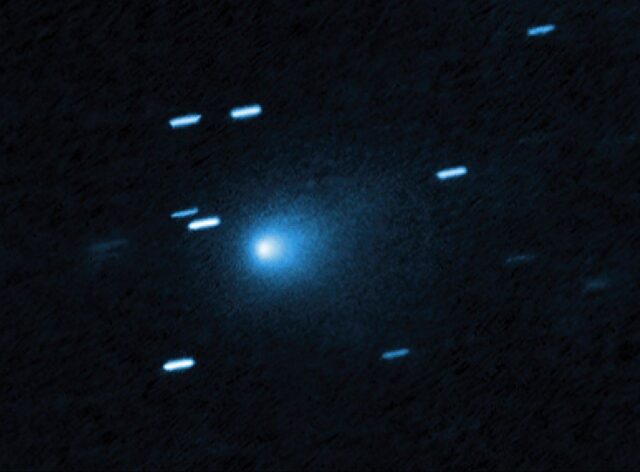
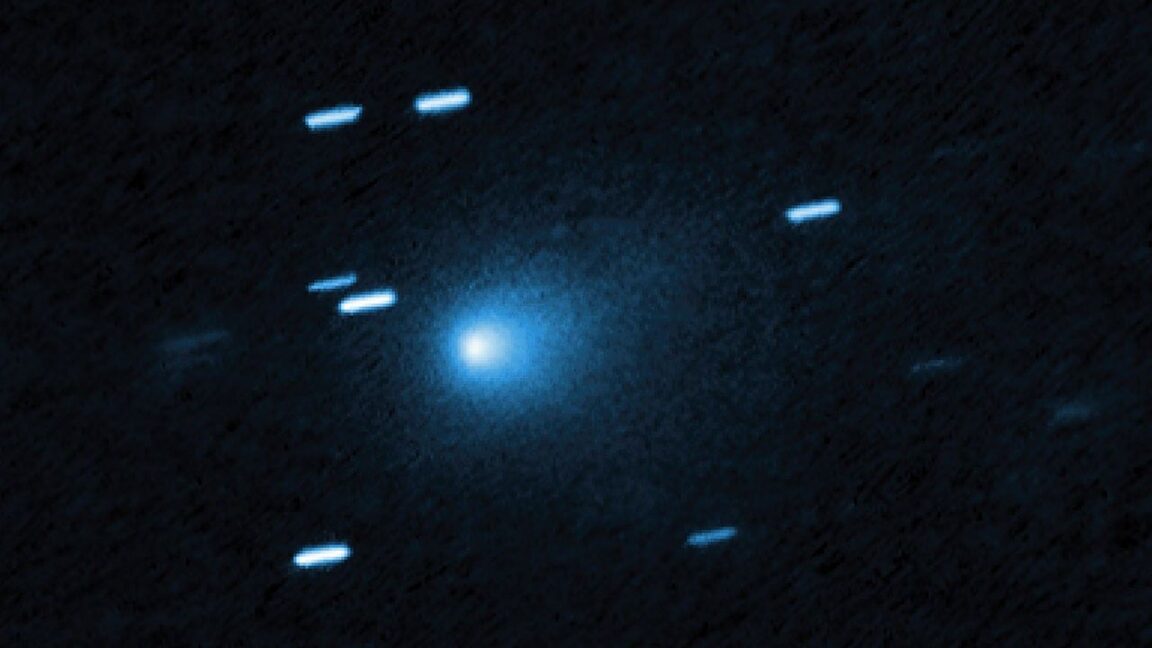
A Hubble telescope image of the comet. Credit: NASA, ESA, David Jewitt (UCLA)
Since early July, telescopes around the world have been tracking just our third confirmed interstellar visitor, the comet 3I/ATLAS—3I, for third interstellar, and ATLAS (Asteroid Terrestrial-impact Last Alert System) for the telescope network that first spotted it. But the object’s closest approach to the Sun came in late October during the US government shutdown. So, while enough people went to work to ensure that the hardware continued to do its job, nobody was available at NASA to make the images available to the public or discuss their implications.
So today, NASA held a press conference to discuss everything that we now know about 3I/ATLAS, and how NASA’s hardware contributed to that knowledge. And to say one more time that the object is a fairly typical comet and not some spaceship doing its best to appear like one.
Extrasolar comet
3I/ATLAS is an extrasolar comet and the third visitor from another star that we’ve detected. We know the comet part because it looks like one, forming a coma of gas and dust, as well as a tail, as the Sun heats up its materials. That hasn’t stopped the usual suspect (Avi Loeb) from speculating that it might be a spacecraft, as he had for the earlier visitors. NASA doesn’t want to hear it. “This object is a comet,” said Associate Administrator Amit Kshatrya. “It looks and behaves like a comet, and all evidence points to it being a comet.”
The extrasolar descriptor comes from the shape of its orbit. The orbit’s shape is measured by eccentricity; an eccentricity of zero is a perfect circle, and that shifts to ever-narrower and longer ellipses as the eccentricity rises. By the time it hits one, gravity is no longer able to bend the far end of the ellipse closed. Instead, an object will trace a very narrow parabola—think something shaped like the business end of a champagne glass—before it escapes the gravitational clutches of the Sun and heads off into the galaxy.
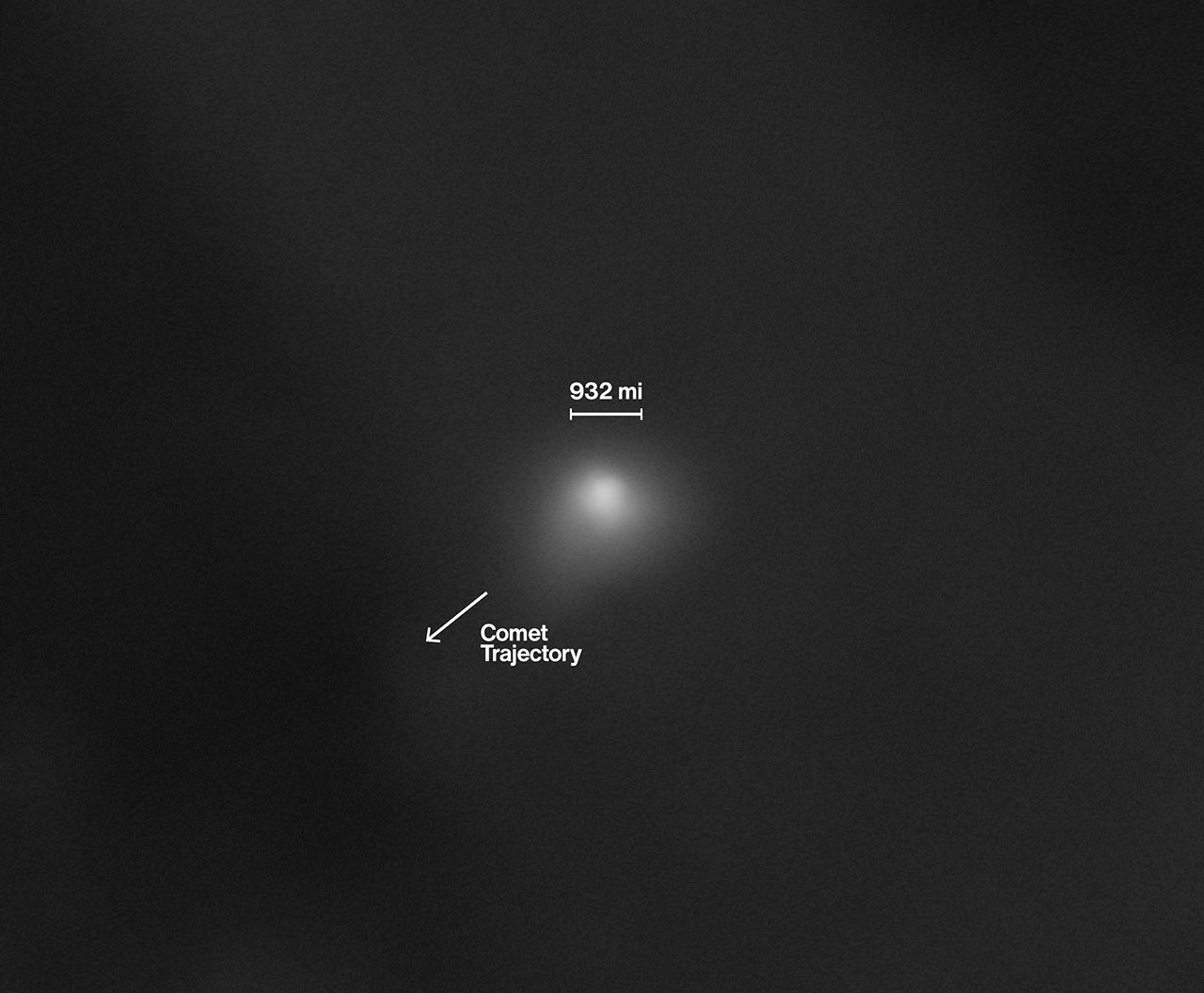
The HiRISE camera, meant to image Mars’ surface, was repurposed to capture 3I/ATLAS. Credit: NASA/JPL-Caltech/University of Arizona
As eccentricity continues to rise from there, the question shifts from “what shape is its trajectory?” to “how much does the Sun alter its path through the Solar System?” For 3I/Atlas, with an eccentricity of over six, the answer is “not very much at all.” The object has approached the inner Solar System along a reasonable approximation of a straight line, experienced a gentle bend around the Sun near Mars’ orbit, and now will be zipping straight out of the Solar System again.
So, the object clearly did not originate here, which means getting a better look at it is a high priority. Unfortunately, 3I/ATLAS’s closest approach to Earth’s orbit happened when it was on the far side of the Sun from Earth. We’ve been getting closer to it since, but the hardware that got the best views was all orbiting Mars and is designed largely to point down. NASA’s Nicky Fox, the associate administrator for Science, praised the operators for getting NASA’s hardware “pushed beyond their designed capabilities” when imaging the object.
That includes using the MAVEN mission (designed to study Mars’ atmosphere) to get spectral information, and the HiRISE camera, which captured the image below. Other images came from a solar observatory and two separate missions that are on their way to visit asteroids. Other hardware that can normally image objects like this, such as the Hubble and JWST, pivoted to image 3I/ATLAS as well.
What we now know
Hubble has gotten the best view of 3I/ATLAS; its data suggests that the comet is, at most, just a couple of kilometers across. It doesn’t show much variability over time, suggesting that, if it’s rotating, it’s doing so very slowly. It has shown some differences as it warmed up, first producing a jet of material on its side facing the Sun before radiation pressure pushed that behind it to form a tail. There is some indication that, as we saw during the Rosetta mission’s visit to one of our Solar System’s comets, most of the material may be jetting out of distinct “hotspots” on the comet’s surface.
Imaging suggests that a lot of the material coming off is in the form of dust grains. NASA indicated that two missions to asteroids, Lucy and Psyche, were especially helpful here, since they were farther from the Sun than 3I/ATLAS, and so could capture backlit images of the comet’s coma.
NASA’s Tom Statler, the lead scientist for Solar System bodies, said that the amount of material being released by 3I/ATLAS is fairly typical of Solar System comets. But some of the details are a bit unusual. For example, the ratio of carbon dioxide to water being released is higher than we see from local comets. Those normally emit iron and nickel together, but 3I/ATLAS seems to be unusually nickel-rich. So, there are indications that it has a history that differs somewhat from our Solar System’s comets.
That history is tough to discern. 3I/ATLAS came from the direction of the galactic core, and doesn’t appear likely to have interacted with any other stars recently. If that’s right, then it’s possible that the object is older than the Solar System itself, and came from a star that formed relatively early in the Universe’s history, and thus had far fewer of the heavy elements.
For now, NASA has put up a webpage with a large collection of images of 3I/ATLAS and will update the site as more photos become available. But the scientists on the call today emphasized that it’s still very early going in terms of analysis, and some of these ideas may be refined as they make their way through discussions among scientists and peer review at journals.
Fox also made it clear that we were able to quickly spot and characterize the orbit of 3I/ATLAS partly because we’ve set up systems to identify any Earth-threatening objects as part of our planetary defense program. With that and other automated surveys in place, it’s likely that the three objects we’ve seen so far (two comets, one asteroid) will gradually be joined by others, and we’ll be able to build up a clearer picture of what’s floating out among the stars.

A Hubble telescope image of the comet. Credit: NASA, ESA, David Jewitt (UCLA)
Since early July, telescopes around the world have been tracking just our third confirmed interstellar visitor, the comet 3I/ATLAS—3I, for third interstellar, and ATLAS (Asteroid Terrestrial-impact Last Alert System) for the telescope network that first spotted it. But the object’s closest approach to the Sun came in late October during the US government shutdown. So, while enough people went to work to ensure that the hardware continued to do its job, nobody was available at NASA to make the images available to the public or discuss their implications.
So today, NASA held a press conference to discuss everything that we now know about 3I/ATLAS, and how NASA’s hardware contributed to that knowledge. And to say one more time that the object is a fairly typical comet and not some spaceship doing its best to appear like one.
Extrasolar comet
3I/ATLAS is an extrasolar comet and the third visitor from another star that we’ve detected. We know the comet part because it looks like one, forming a coma of gas and dust, as well as a tail, as the Sun heats up its materials. That hasn’t stopped the usual suspect (Avi Loeb) from speculating that it might be a spacecraft, as he had for the earlier visitors. NASA doesn’t want to hear it. “This object is a comet,” said Associate Administrator Amit Kshatrya. “It looks and behaves like a comet, and all evidence points to it being a comet.”
The extrasolar descriptor comes from the shape of its orbit. The orbit’s shape is measured by eccentricity; an eccentricity of zero is a perfect circle, and that shifts to ever-narrower and longer ellipses as the eccentricity rises. By the time it hits one, gravity is no longer able to bend the far end of the ellipse closed. Instead, an object will trace a very narrow parabola—think something shaped like the business end of a champagne glass—before it escapes the gravitational clutches of the Sun and heads off into the galaxy.
The HiRISE camera, meant to image Mars’ surface, was repurposed to capture 3I/ATLAS. Credit: NASA/JPL-Caltech/University of Arizona
As eccentricity continues to rise from there, the question shifts from “what shape is its trajectory?” to “how much does the Sun alter its path through the Solar System?” For 3I/Atlas, with an eccentricity of over six, the answer is “not very much at all.” The object has approached the inner Solar System along a reasonable approximation of a straight line, experienced a gentle bend around the Sun near Mars’ orbit, and now will be zipping straight out of the Solar System again.
So, the object clearly did not originate here, which means getting a better look at it is a high priority. Unfortunately, 3I/ATLAS’s closest approach to Earth’s orbit happened when it was on the far side of the Sun from Earth. We’ve been getting closer to it since, but the hardware that got the best views was all orbiting Mars and is designed largely to point down. NASA’s Nicky Fox, the associate administrator for Science, praised the operators for getting NASA’s hardware “pushed beyond their designed capabilities” when imaging the object.
That includes using the MAVEN mission (designed to study Mars’ atmosphere) to get spectral information, and the HiRISE camera, which captured the image below. Other images came from a solar observatory and two separate missions that are on their way to visit asteroids. Other hardware that can normally image objects like this, such as the Hubble and JWST, pivoted to image 3I/ATLAS as well.
What we now know
Hubble has gotten the best view of 3I/ATLAS; its data suggests that the comet is, at most, just a couple of kilometers across. It doesn’t show much variability over time, suggesting that, if it’s rotating, it’s doing so very slowly. It has shown some differences as it warmed up, first producing a jet of material on its side facing the Sun before radiation pressure pushed that behind it to form a tail. There is some indication that, as we saw during the Rosetta mission’s visit to one of our Solar System’s comets, most of the material may be jetting out of distinct “hotspots” on the comet’s surface.
Imaging suggests that a lot of the material coming off is in the form of dust grains. NASA indicated that two missions to asteroids, Lucy and Psyche, were especially helpful here, since they were farther from the Sun than 3I/ATLAS, and so could capture backlit images of the comet’s coma.
NASA’s Tom Statler, the lead scientist for Solar System bodies, said that the amount of material being released by 3I/ATLAS is fairly typical of Solar System comets. But some of the details are a bit unusual. For example, the ratio of carbon dioxide to water being released is higher than we see from local comets. Those normally emit iron and nickel together, but 3I/ATLAS seems to be unusually nickel-rich. So, there are indications that it has a history that differs somewhat from our Solar System’s comets.
That history is tough to discern. 3I/ATLAS came from the direction of the galactic core, and doesn’t appear likely to have interacted with any other stars recently. If that’s right, then it’s possible that the object is older than the Solar System itself, and came from a star that formed relatively early in the Universe’s history, and thus had far fewer of the heavy elements.
For now, NASA has put up a webpage with a large collection of images of 3I/ATLAS and will update the site as more photos become available. But the scientists on the call today emphasized that it’s still very early going in terms of analysis, and some of these ideas may be refined as they make their way through discussions among scientists and peer review at journals.
Fox also made it clear that we were able to quickly spot and characterize the orbit of 3I/ATLAS partly because we’ve set up systems to identify any Earth-threatening objects as part of our planetary defense program. With that and other automated surveys in place, it’s likely that the three objects we’ve seen so far (two comets, one asteroid) will gradually be joined by others, and we’ll be able to build up a clearer picture of what’s floating out among the stars.
