


- Регистрация
- 17 Февраль 2018
- Сообщения
- 41 105
- Лучшие ответы
- 0
- Реакции
- 0
- Баллы
- 8 093
Offline
The next Starship flight is a key precursor for more ambitious missions.
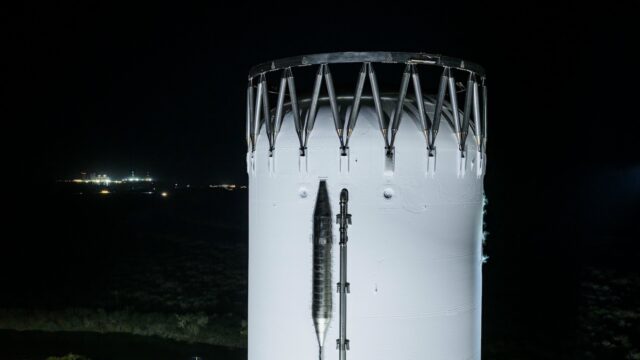
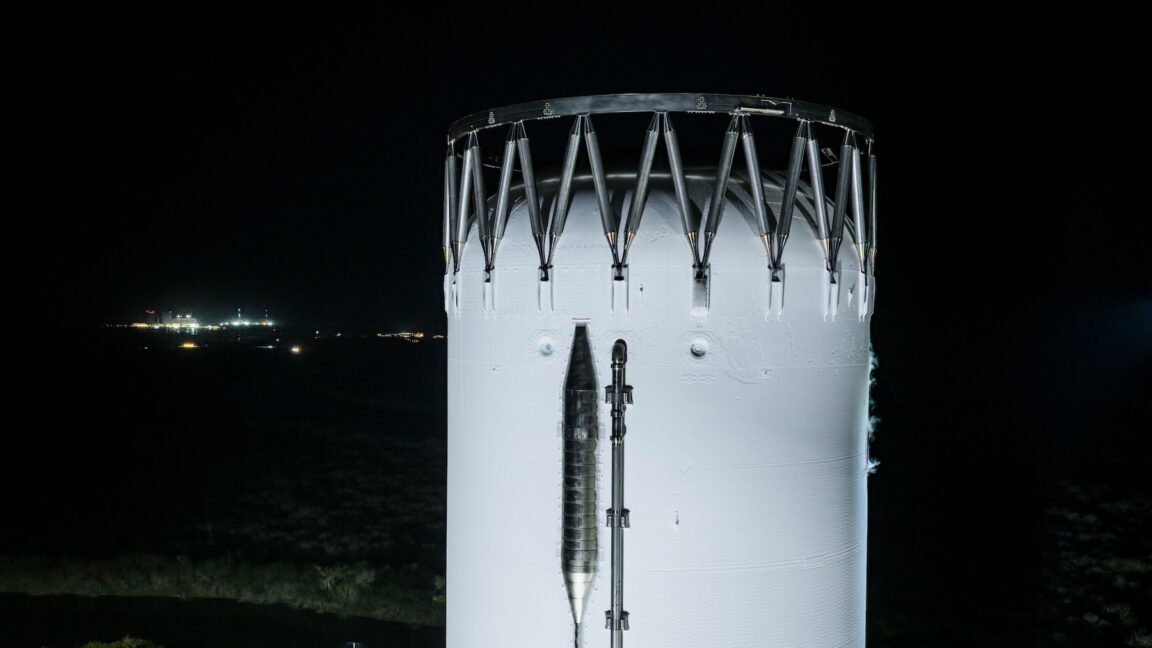
The top of SpaceX's Super Heavy booster, covered in ice during a cryogenic proof test at Starbase, Texas. Credit: SpaceX
The upgraded Super Heavy booster slated to launch SpaceX’s next Starship flight has completed cryogenic proof testing, clearing a hurdle that resulted in the destruction of the company’s previous booster.
SpaceX announced the milestone in a social media post Tuesday: “Cryoproof operations complete for the first time with a Super Heavy V3 booster. This multi-day campaign tested the booster’s redesigned propellant systems and its structural strength.”
Ground teams at Starbase, Texas, rolled the 237-foot-tall (72.3-meter) stainless-steel booster out of its factory and transported it a few miles away to Massey’s Test Site last week. The test crew first performed a pressure test on the rocket at ambient temperatures, then loaded super-cold liquid nitrogen into the rocket four times over six days, putting the booster through repeated thermal and pressurization cycles. The nitrogen is a stand-in for the cryogenic methane and liquid oxygen that will fill the booster’s propellant tanks on launch day.
The proof test is notable because it moves engineers closer to launching the first test flight of an upgraded version of SpaceX’s mega-rocket named Starship V3 or Block 3. SpaceX launched the previous version, Starship V2, five times last year, but the first three test flights failed. The last two flights achieved SpaceX’s goals, and the company moved on to V3.
Better results this time
The Super Heavy booster originally assigned to the first Starship V3 test flight failed during a pressure test in November. The rocket’s liquid oxygen tank ruptured under pressure, and SpaceX scrapped the booster and moved on to the next in line—Booster 19. This Super Heavy vehicle appears have sailed through stress testing, and SpaceX returned the booster to the factory early Monday. There, technicians will mount 33 Raptor engines to the bottom of the rocket and install the booster’s grid fins.
These components are changed from Starship V2. The Raptor engines set to debut on Starship V3 produce more thrust and include changes to improve reliability, according to SpaceX. The Raptor 3s are lighter with plumbing and sensors integrated into the engine’s main structure, eliminating the requirement for self-contained heat shields between the engines at the base of the rocket.
The new booster design only uses three grid fins, not four, to provide controllability during descent. The aerosurfaces help stabilize the rocket as it returns to Earth for recovery. The hot-staging ring at the top of the new version of the Super Heavy booster is integrated with the rocket to enable its return to Earth for reuse. The ring was jettisoned and expended on previous Starship flights.
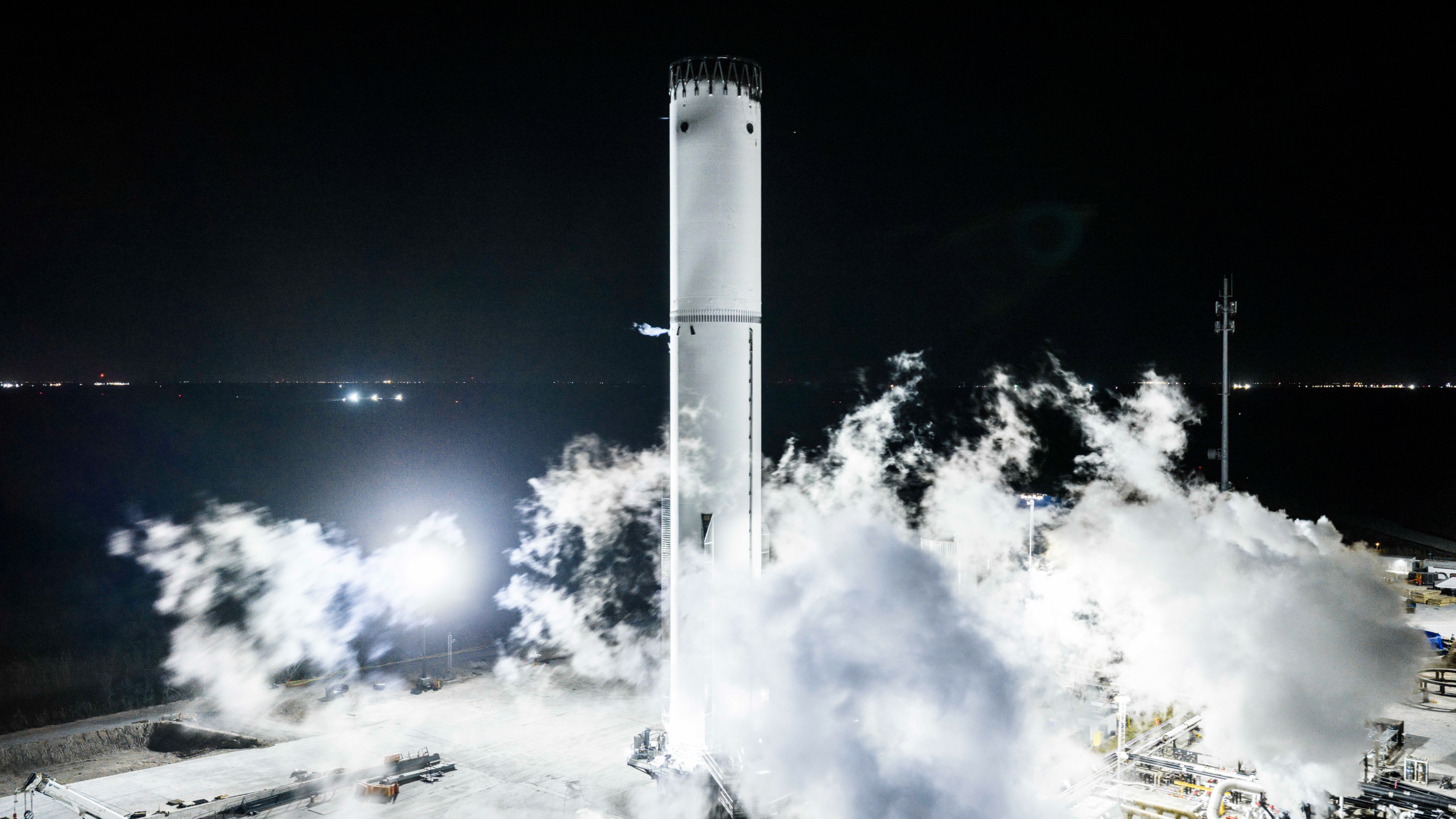
Vapors from the boil-off of cryogenic liquid nitrogen surround the 237-foot-tall (72.3-meter) Super Heavy booster. Credit: SpaceX
After receiving its engines and grid fins, the Super Heavy booster will roll out to the launch pad at Starbase. SpaceX’s launch team will fill it with methane and liquid oxygen for a test-firing of its 33 engines.
Meanwhile, the first of SpaceX’s upgraded Starship vehicles—essentially the upper stage that flies on top of the Super Heavy booster—will travel to the Massey’s Test Site for its own cryogenic proof test campaign. It is also expected to undergo a static fire test of its six Raptor engines.
Assuming that all goes according to plan, SpaceX could be in position to launch the first Starship V3 test flight before the end of March. This will be the 12th full-scale Starship/Super Heavy test flight overall, and the mission will likely follow the same trajectory as previous flights, with Starship arcing halfway around the world from South Texas to a controlled reentry and splashdown in the Indian Ocean.
With the upcoming launch, SpaceX is eager to prove Starship V3’s readiness for more ambitious test flights, including an important orbital refueling experiment considered a stepping stone toward sending future Starships to the Moon, Mars, and other distant destinations.
NASA officials are closely watching Starship V3’s development because the refueling demonstration is on the critical path for the agency’s Artemis lunar program. A human-rated version of Starship is NASA’s primary option for a Moon lander to ferry astronauts to and from the lunar surface on the Artemis III mission, the next Artemis flight after the Artemis II circumlunar mission that is awaiting liftoff in the coming weeks.
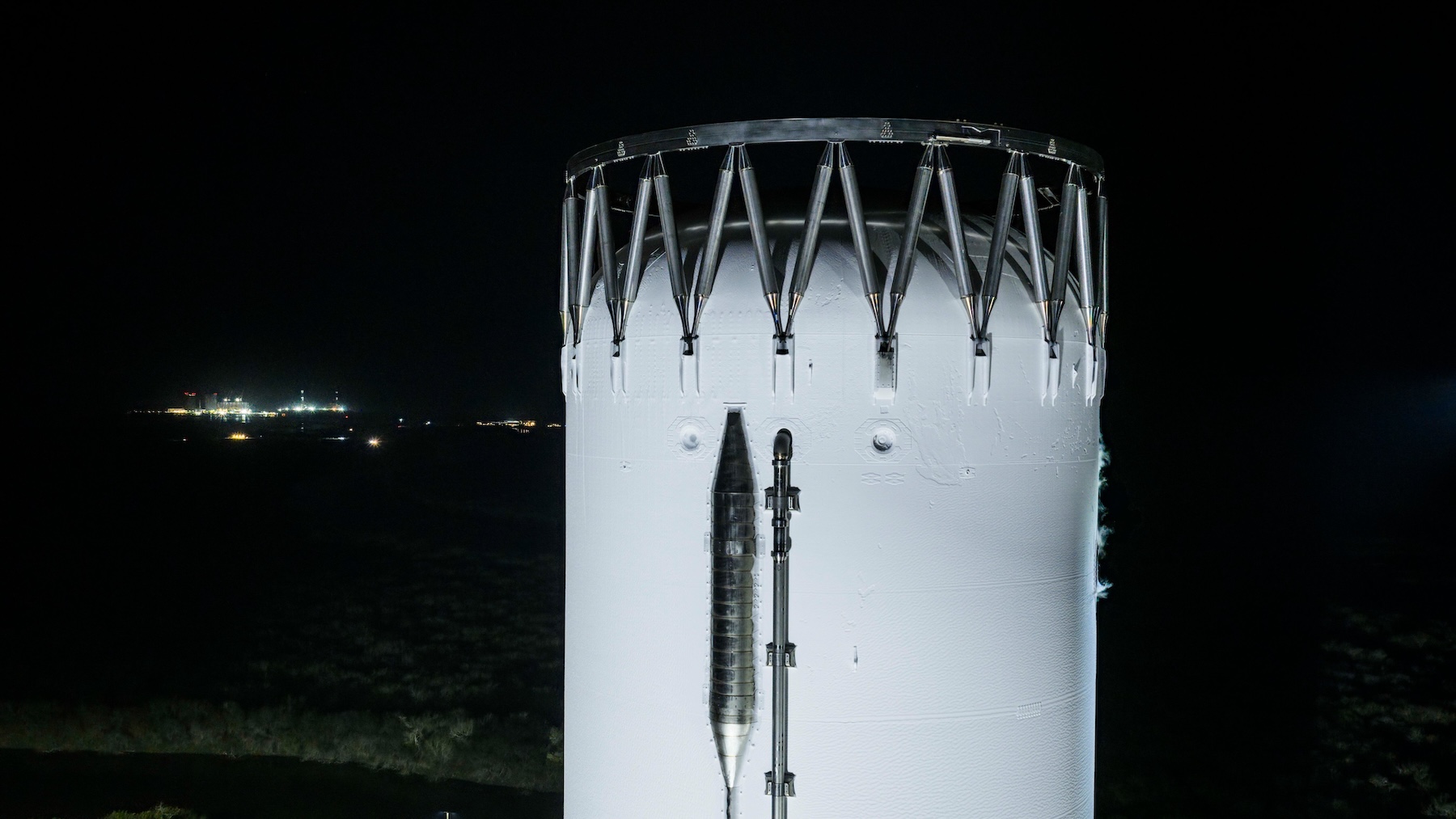
The top of SpaceX's Super Heavy booster, covered in ice during a cryogenic proof test at Starbase, Texas. Credit: SpaceX
The upgraded Super Heavy booster slated to launch SpaceX’s next Starship flight has completed cryogenic proof testing, clearing a hurdle that resulted in the destruction of the company’s previous booster.
SpaceX announced the milestone in a social media post Tuesday: “Cryoproof operations complete for the first time with a Super Heavy V3 booster. This multi-day campaign tested the booster’s redesigned propellant systems and its structural strength.”
Ground teams at Starbase, Texas, rolled the 237-foot-tall (72.3-meter) stainless-steel booster out of its factory and transported it a few miles away to Massey’s Test Site last week. The test crew first performed a pressure test on the rocket at ambient temperatures, then loaded super-cold liquid nitrogen into the rocket four times over six days, putting the booster through repeated thermal and pressurization cycles. The nitrogen is a stand-in for the cryogenic methane and liquid oxygen that will fill the booster’s propellant tanks on launch day.
The proof test is notable because it moves engineers closer to launching the first test flight of an upgraded version of SpaceX’s mega-rocket named Starship V3 or Block 3. SpaceX launched the previous version, Starship V2, five times last year, but the first three test flights failed. The last two flights achieved SpaceX’s goals, and the company moved on to V3.
Better results this time
The Super Heavy booster originally assigned to the first Starship V3 test flight failed during a pressure test in November. The rocket’s liquid oxygen tank ruptured under pressure, and SpaceX scrapped the booster and moved on to the next in line—Booster 19. This Super Heavy vehicle appears have sailed through stress testing, and SpaceX returned the booster to the factory early Monday. There, technicians will mount 33 Raptor engines to the bottom of the rocket and install the booster’s grid fins.
These components are changed from Starship V2. The Raptor engines set to debut on Starship V3 produce more thrust and include changes to improve reliability, according to SpaceX. The Raptor 3s are lighter with plumbing and sensors integrated into the engine’s main structure, eliminating the requirement for self-contained heat shields between the engines at the base of the rocket.
The new booster design only uses three grid fins, not four, to provide controllability during descent. The aerosurfaces help stabilize the rocket as it returns to Earth for recovery. The hot-staging ring at the top of the new version of the Super Heavy booster is integrated with the rocket to enable its return to Earth for reuse. The ring was jettisoned and expended on previous Starship flights.
Vapors from the boil-off of cryogenic liquid nitrogen surround the 237-foot-tall (72.3-meter) Super Heavy booster. Credit: SpaceX
After receiving its engines and grid fins, the Super Heavy booster will roll out to the launch pad at Starbase. SpaceX’s launch team will fill it with methane and liquid oxygen for a test-firing of its 33 engines.
Meanwhile, the first of SpaceX’s upgraded Starship vehicles—essentially the upper stage that flies on top of the Super Heavy booster—will travel to the Massey’s Test Site for its own cryogenic proof test campaign. It is also expected to undergo a static fire test of its six Raptor engines.
Assuming that all goes according to plan, SpaceX could be in position to launch the first Starship V3 test flight before the end of March. This will be the 12th full-scale Starship/Super Heavy test flight overall, and the mission will likely follow the same trajectory as previous flights, with Starship arcing halfway around the world from South Texas to a controlled reentry and splashdown in the Indian Ocean.
With the upcoming launch, SpaceX is eager to prove Starship V3’s readiness for more ambitious test flights, including an important orbital refueling experiment considered a stepping stone toward sending future Starships to the Moon, Mars, and other distant destinations.
NASA officials are closely watching Starship V3’s development because the refueling demonstration is on the critical path for the agency’s Artemis lunar program. A human-rated version of Starship is NASA’s primary option for a Moon lander to ferry astronauts to and from the lunar surface on the Artemis III mission, the next Artemis flight after the Artemis II circumlunar mission that is awaiting liftoff in the coming weeks.
