


- Регистрация
- 17 Февраль 2018
- Сообщения
- 40 948
- Лучшие ответы
- 0
- Реакции
- 0
- Баллы
- 8 093
Offline
“We can’t keep everyone living on that first ship that sailed to North America.”
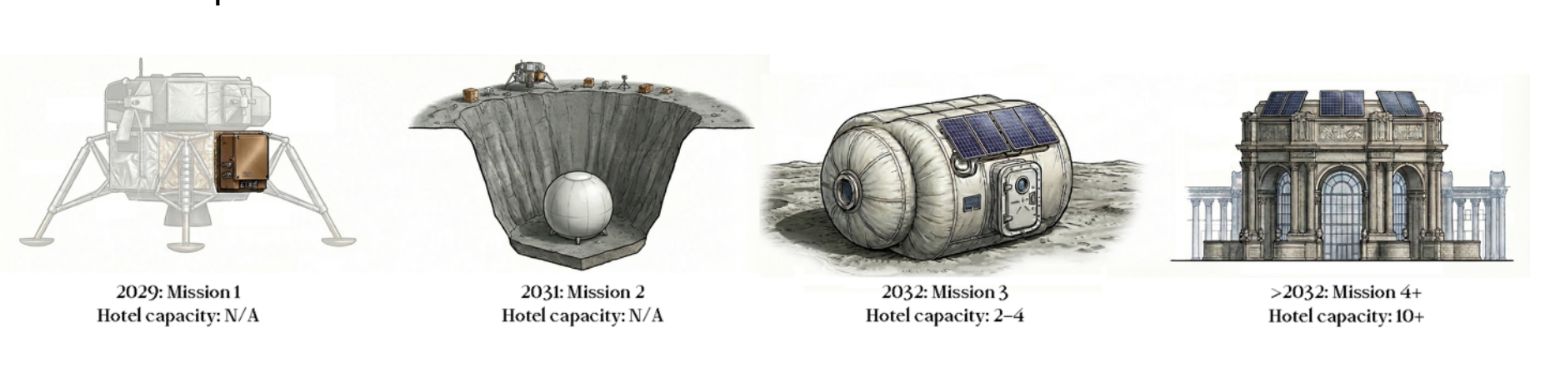
How to build a lunar hotel. Credit: GRU Space
A company called GRU Space publicly announced its intent to construct a series of increasingly sophisticated habitats on the Moon, culminating in a hotel inspired by the Palace of the Fine Arts in San Francisco.
On Monday, the company invited those interested in a berth to plunk down a deposit between $250,000 and $1 million, qualifying them for a spot on one of its early lunar surface missions in as little as six years from now.
It sounds crazy, doesn’t it? After all, GRU Space had, as of late December when I spoke to founder Skyler Chan, a single full-time employee aside from himself. And Chan, in fact, only recently graduated from the University of California, Berkeley.
All of this could therefore be dismissed as a lark. But I must say that I am a sucker for these kinds of stories. Chan is perfectly earnest about all of this. And despite all of the talk about lunar resources, my belief is that the surest long-term commercial activity on the Moon will be lunar tourism—it would be an amazing destination.
So when I interviewed Chan, I did so with an open mind.
Who are the customers?
Like many younger people, Chan grew up wanting to become an astronaut. But along the way, in high school and later college, he came to believe that he could lead a more impactful life by enabling everyone to go to space, not just himself.
“I realized I was born in this time where we can actually become interplanetary, and that is probably the singular most impactful thing one person could do with their time,” Chan said. “So I charged towards building the systems necessary and technology to enable that future. That’s actually what led me to go to Berkeley to study electrical engineering and computer science.”
He had some interesting experiences in college, interning at Tesla to write vehicle software, and building a NASA-funded 3D printer launched into space. Chan also had a stunning realization about the Moon. There were all of these people building cool technology to get humans to the Moon. But he realized that the vast majority of this activity was backed by two pillars: the US government and billionaire-funded companies. Who, he wondered, was the ultimate customer for these services? And were there actually any commercial customers for what was being sold?
“I realized we needed to create a third pillar: the space tourism industry,” he said. “We could extend a proven market to the Moon, and build the first hotel there. And then once we build the hotel on the Moon, we can build out our structures, you know, roads, warehouses, and bases. And then we can repeat that on Mars. So that’s what I decided to do.”
He graduated in May 2025, a year early.
Yeah, this does sound pretty crazy, but …
The GRU in the company’s name, by the way, stands for Galactic Resource Utilization. The long-term vision is to derive resources from the Moon, Mars, asteroids, and beyond to fuel human expansion into space.
If all that sounds audacious and unrealistic, well, it kind of is. But it is not without foundation. GRU Space has already received seed funding from Y Combinator, and it will go through the organization’s three-month program early this year. This will help Chan refine his company’s product and give him more options to raise money. Regarding his vision, you can read GRU Space’s white paper here.
Presently, the company plans to fly its initial “mission” in 2029 as a 10-kg payload on a commercial lunar lander, demonstrating an inflatable structure capability and converting lunar regolith into Moon bricks using geopolymers. With its second mission, the company plans to launch a larger inflatable structure into a “lunar pit” to test a scaled-up version of its resource development capabilities.
The first hotel, an inflatable structure, would be launched in 2032 and would be capable of supporting up to four guests at a time. The next iteration beyond this would be the fancier structure, built from Moon bricks, in the style of the Palace of the Fine Arts.
One question I had was: Why have a hotel at all? Presumably, the company’s customers will be riding to the Moon inside SpaceX’s Starship, which will have plenty of interior room and proven life support equipment by the time tourists are flying aboard it (if they ever do).
“SpaceX is building the FedEx to get us there, right?” Chan said. “But there has to be a destination worthy to stay in. Obviously, there is all kinds of debate around this, and what the future is going to be like. But our conviction is that the fundamental problem we have to solve, to advance humans toward the Moon and Mars, is off-world habitation. We can’t keep everyone living on that first ship that sailed to North America, right? We have to build the roads and structures and offices that we live in today.”
How to build a lunar hotel. Credit: GRU Space
A company called GRU Space publicly announced its intent to construct a series of increasingly sophisticated habitats on the Moon, culminating in a hotel inspired by the Palace of the Fine Arts in San Francisco.
On Monday, the company invited those interested in a berth to plunk down a deposit between $250,000 and $1 million, qualifying them for a spot on one of its early lunar surface missions in as little as six years from now.
It sounds crazy, doesn’t it? After all, GRU Space had, as of late December when I spoke to founder Skyler Chan, a single full-time employee aside from himself. And Chan, in fact, only recently graduated from the University of California, Berkeley.
All of this could therefore be dismissed as a lark. But I must say that I am a sucker for these kinds of stories. Chan is perfectly earnest about all of this. And despite all of the talk about lunar resources, my belief is that the surest long-term commercial activity on the Moon will be lunar tourism—it would be an amazing destination.
So when I interviewed Chan, I did so with an open mind.
Who are the customers?
Like many younger people, Chan grew up wanting to become an astronaut. But along the way, in high school and later college, he came to believe that he could lead a more impactful life by enabling everyone to go to space, not just himself.
“I realized I was born in this time where we can actually become interplanetary, and that is probably the singular most impactful thing one person could do with their time,” Chan said. “So I charged towards building the systems necessary and technology to enable that future. That’s actually what led me to go to Berkeley to study electrical engineering and computer science.”
He had some interesting experiences in college, interning at Tesla to write vehicle software, and building a NASA-funded 3D printer launched into space. Chan also had a stunning realization about the Moon. There were all of these people building cool technology to get humans to the Moon. But he realized that the vast majority of this activity was backed by two pillars: the US government and billionaire-funded companies. Who, he wondered, was the ultimate customer for these services? And were there actually any commercial customers for what was being sold?
“I realized we needed to create a third pillar: the space tourism industry,” he said. “We could extend a proven market to the Moon, and build the first hotel there. And then once we build the hotel on the Moon, we can build out our structures, you know, roads, warehouses, and bases. And then we can repeat that on Mars. So that’s what I decided to do.”
He graduated in May 2025, a year early.
Yeah, this does sound pretty crazy, but …
The GRU in the company’s name, by the way, stands for Galactic Resource Utilization. The long-term vision is to derive resources from the Moon, Mars, asteroids, and beyond to fuel human expansion into space.
If all that sounds audacious and unrealistic, well, it kind of is. But it is not without foundation. GRU Space has already received seed funding from Y Combinator, and it will go through the organization’s three-month program early this year. This will help Chan refine his company’s product and give him more options to raise money. Regarding his vision, you can read GRU Space’s white paper here.
Presently, the company plans to fly its initial “mission” in 2029 as a 10-kg payload on a commercial lunar lander, demonstrating an inflatable structure capability and converting lunar regolith into Moon bricks using geopolymers. With its second mission, the company plans to launch a larger inflatable structure into a “lunar pit” to test a scaled-up version of its resource development capabilities.
The first hotel, an inflatable structure, would be launched in 2032 and would be capable of supporting up to four guests at a time. The next iteration beyond this would be the fancier structure, built from Moon bricks, in the style of the Palace of the Fine Arts.
One question I had was: Why have a hotel at all? Presumably, the company’s customers will be riding to the Moon inside SpaceX’s Starship, which will have plenty of interior room and proven life support equipment by the time tourists are flying aboard it (if they ever do).
“SpaceX is building the FedEx to get us there, right?” Chan said. “But there has to be a destination worthy to stay in. Obviously, there is all kinds of debate around this, and what the future is going to be like. But our conviction is that the fundamental problem we have to solve, to advance humans toward the Moon and Mars, is off-world habitation. We can’t keep everyone living on that first ship that sailed to North America, right? We have to build the roads and structures and offices that we live in today.”
