

- Регистрация
- 17 Фев 2018
- Сообщения
- 42,224
- Реакции
- 0
- Баллы
- 36
Ofline
The MX600 Max doesn't look too special, but it has rear mobo connections, supports 200mm fans, and can swap its I/O panel from top to bottom.

Image: Cougar/some random internet person
Summary created by Smart Answers AI
Sometimes it feels like the PC case segment moves at a snail’s pace. The most exciting development I’ve seen in years is rear-mounted connections. But Cougar’s new MX600 MAX RGB case caught my eye as a PC builder focused on utility and performance. The fans are big, and the ports are bigger.
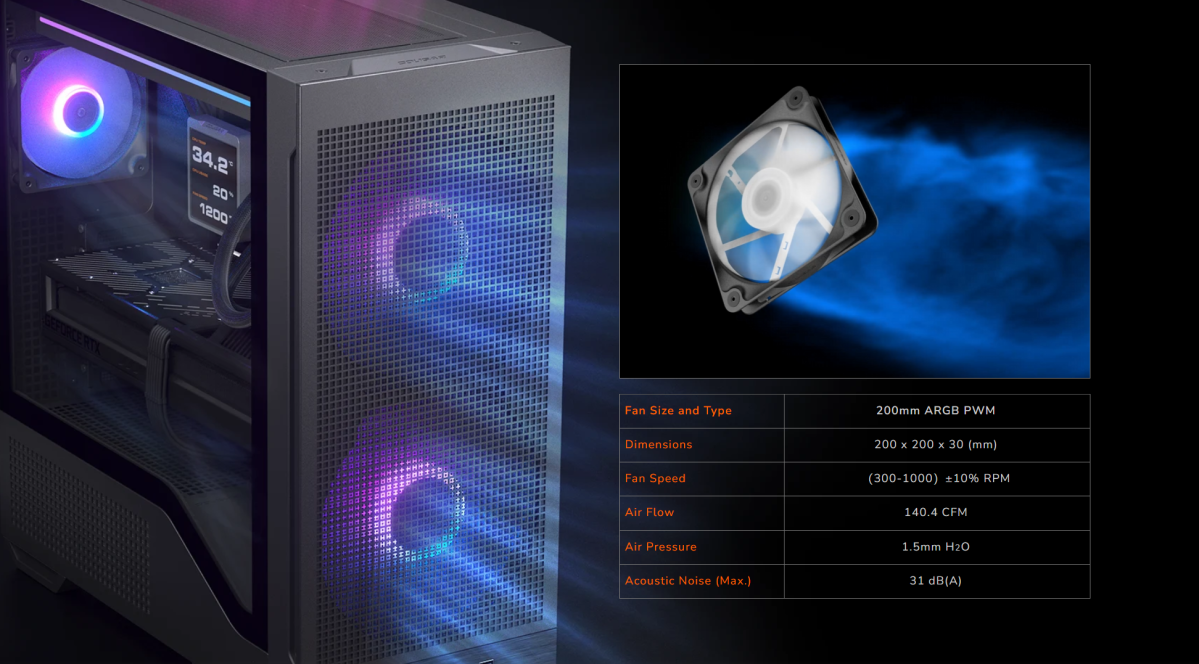
The standard ATX design bucks trends with two massive 200mm fans right on the front air intake panel. That might not seem like much, but by my calculations that’s more than double the fan surface area of a standard 2x140mm fan setup, and still a 33 percent increase over a 3x140mm intake. Add in a ramped cover for the bottom-mounted power supply and you’ve got a nice bit of airflow pointed straight at your GPU. Top-mounted radiators of up to 360mm are supported, and you can even double up on the bottom fans above the PSU, though those will be just 120mm. GPU support extends to a massive 400mm.
Cougar
But size isn’t everything. According to Cougar’s promotional site, the 200mm PWM fans each operate at a maximum of 1,000 RPM, pushing 140.4 cubic feet per minute (CFM). Compare that to a standard 140mm fan from Corsair, which maxes out at 95.5 CFM according to its specs. Of course, there’s nothing stopping you from installing any other 200mm fan that prioritizes speed or quiet—those big blades mean you can lower the RPM to move the same amount of air at a lower noise level.
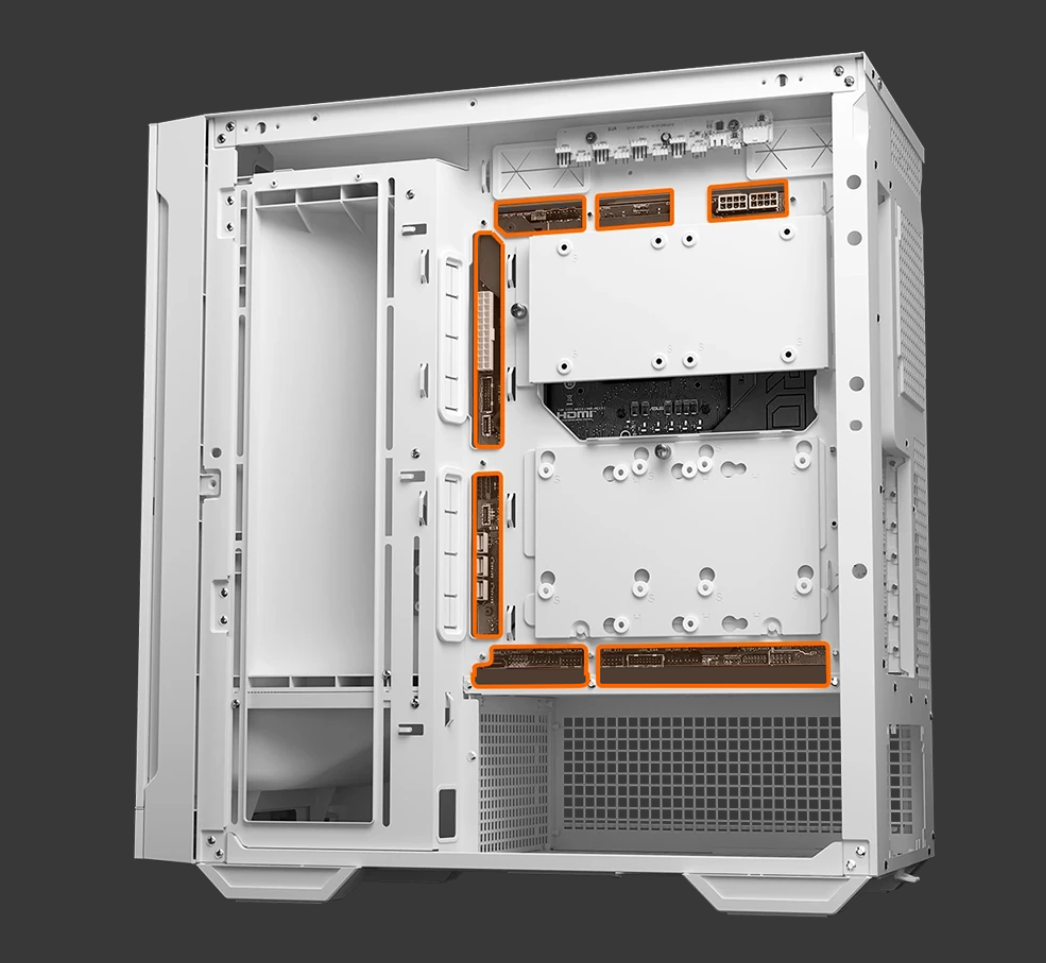
Elsewhere, the MX600 offers a few other tricks, though no options for 5.25-inch drives. (You can’t fit them around those massive fans!) Storage is mounted behind the motherboard tray with room for up to four 2.5-inch drives or just two 3.5-inch ones. Speaking of the motherboard, yes, you can fit rear-facing connectors in there for ultra-sleek cable routing, though I’d double-check precisely where those ports are on your motherboard. There’s also a fan controller back there.
Cougar
The inside isn’t the only place where you’ve got movable port options. The MX600’s front I/O panel features two USB-A ports, USB-C 3.2, and an audio jack. Pretty basic. But it can be moved around, swapping from the bottom of the case to the top as needed.
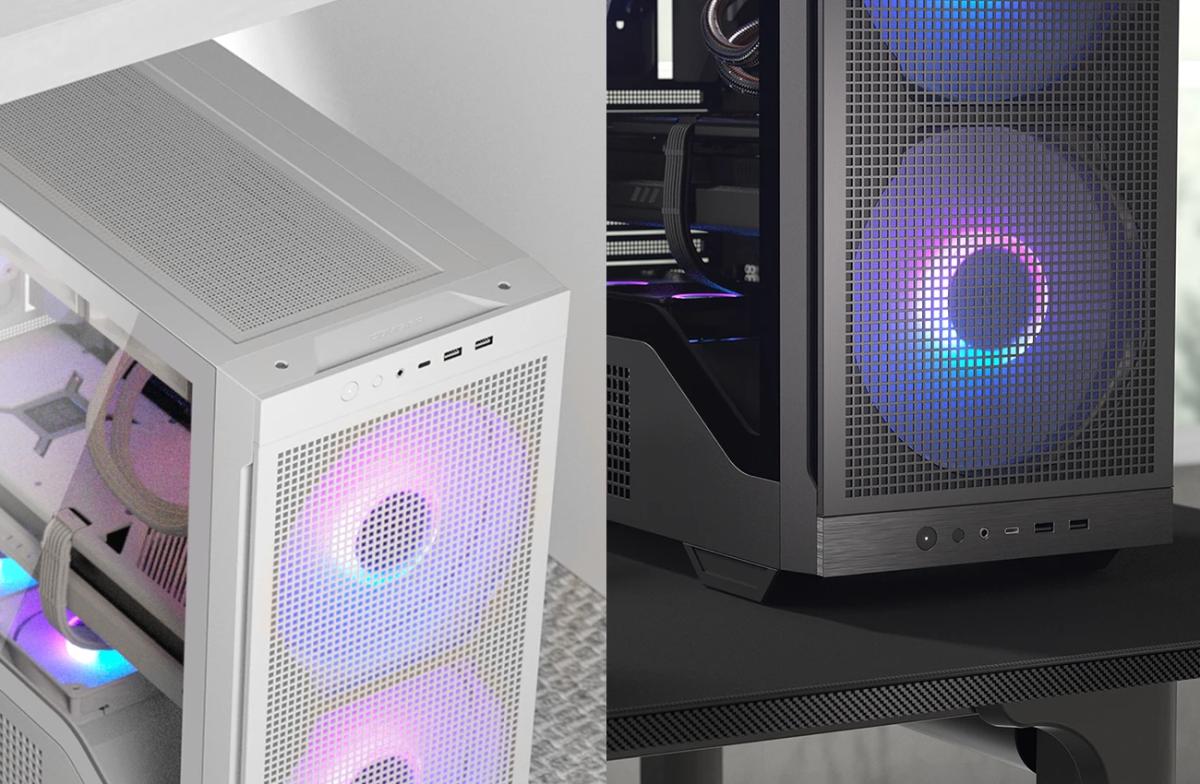
Both the black and white versions of the case can move these I/O ports around.
Cougar
That’s. Freakin’. Huge. At least for me, because I use a standing desk and mount my PC underneath it, both for easy access and to keep the cables nice and organized on a moving surface. If a case has I/O ports mounted in a non-standard place like the top, I can’t really use it. Things get awkward if they’re on the bottom, too—I have to step away from my desk to plug anything in. For my Fractal Design North, I have to awkwardly plug in a mobile dock and tape it to the bottom of my desk’s surface, just so I don’t have to scrape my knuckles to get at the USB ports.
Cougar solved this problem. This case isn’t as stylish as my North—I don’t want to look at my desktop’s guts, so I wish it had a standard steel side option, and I don’t need fancy RGBs. But dang, between that cooling performance and the option to move the front I/O panel around, I might just have to buy it and migrate everything over.
Of course, I’ll have to actually find one first. Cougar hasn’t announced a price or release date for this case, though it will come in black or white. Cougar’s other airflow-focused cases, without fancy “fish tank” glass or screens mounted on them, cost between $80 and $140.

Michael is a 15-year veteran of technology journalism, covering everything from Apple to ZTE. On PCWorld he's the resident keyboard nut, always using a new one for a review and building a new mechanical board or expanding his desktop "battlestation" in his off hours. Michael's previous bylines include Android Police, Digital Trends, Wired, Lifehacker, and How-To Geek, and he's covered events like CES and Mobile World Congress live. Michael lives in Pennsylvania where he's always looking forward to his next kayaking trip.
Image: Cougar/some random internet person
Summary created by Smart Answers AI
In summary:
- PCWorld highlights the Cougar MX600 MAX RGB case featuring two massive 200mm front fans that deliver superior airflow at quieter operation levels.
- The standout innovation is a movable front I/O panel with USB-A, USB-C, and audio connections that adapts to different desk configurations.
- This mid-tower case supports large GPUs up to 400mm, 360mm radiators, and offers flexible storage behind the motherboard tray for clean builds.
Sometimes it feels like the PC case segment moves at a snail’s pace. The most exciting development I’ve seen in years is rear-mounted connections. But Cougar’s new MX600 MAX RGB case caught my eye as a PC builder focused on utility and performance. The fans are big, and the ports are bigger.
The standard ATX design bucks trends with two massive 200mm fans right on the front air intake panel. That might not seem like much, but by my calculations that’s more than double the fan surface area of a standard 2x140mm fan setup, and still a 33 percent increase over a 3x140mm intake. Add in a ramped cover for the bottom-mounted power supply and you’ve got a nice bit of airflow pointed straight at your GPU. Top-mounted radiators of up to 360mm are supported, and you can even double up on the bottom fans above the PSU, though those will be just 120mm. GPU support extends to a massive 400mm.
Cougar
But size isn’t everything. According to Cougar’s promotional site, the 200mm PWM fans each operate at a maximum of 1,000 RPM, pushing 140.4 cubic feet per minute (CFM). Compare that to a standard 140mm fan from Corsair, which maxes out at 95.5 CFM according to its specs. Of course, there’s nothing stopping you from installing any other 200mm fan that prioritizes speed or quiet—those big blades mean you can lower the RPM to move the same amount of air at a lower noise level.
Elsewhere, the MX600 offers a few other tricks, though no options for 5.25-inch drives. (You can’t fit them around those massive fans!) Storage is mounted behind the motherboard tray with room for up to four 2.5-inch drives or just two 3.5-inch ones. Speaking of the motherboard, yes, you can fit rear-facing connectors in there for ultra-sleek cable routing, though I’d double-check precisely where those ports are on your motherboard. There’s also a fan controller back there.
Cougar
The inside isn’t the only place where you’ve got movable port options. The MX600’s front I/O panel features two USB-A ports, USB-C 3.2, and an audio jack. Pretty basic. But it can be moved around, swapping from the bottom of the case to the top as needed.
Both the black and white versions of the case can move these I/O ports around.
Cougar
That’s. Freakin’. Huge. At least for me, because I use a standing desk and mount my PC underneath it, both for easy access and to keep the cables nice and organized on a moving surface. If a case has I/O ports mounted in a non-standard place like the top, I can’t really use it. Things get awkward if they’re on the bottom, too—I have to step away from my desk to plug anything in. For my Fractal Design North, I have to awkwardly plug in a mobile dock and tape it to the bottom of my desk’s surface, just so I don’t have to scrape my knuckles to get at the USB ports.
Cougar solved this problem. This case isn’t as stylish as my North—I don’t want to look at my desktop’s guts, so I wish it had a standard steel side option, and I don’t need fancy RGBs. But dang, between that cooling performance and the option to move the front I/O panel around, I might just have to buy it and migrate everything over.
Of course, I’ll have to actually find one first. Cougar hasn’t announced a price or release date for this case, though it will come in black or white. Cougar’s other airflow-focused cases, without fancy “fish tank” glass or screens mounted on them, cost between $80 and $140.
Author: Michael Crider, Staff Writer, PCWorld
Michael is a 15-year veteran of technology journalism, covering everything from Apple to ZTE. On PCWorld he's the resident keyboard nut, always using a new one for a review and building a new mechanical board or expanding his desktop "battlestation" in his off hours. Michael's previous bylines include Android Police, Digital Trends, Wired, Lifehacker, and How-To Geek, and he's covered events like CES and Mobile World Congress live. Michael lives in Pennsylvania where he's always looking forward to his next kayaking trip.