


- Регистрация
- 17 Февраль 2018
- Сообщения
- 40 832
- Лучшие ответы
- 0
- Реакции
- 0
- Баллы
- 8 093
Offline
LG's new Tandem WOLED panel tech is set to supercharge OLED monitor performance in 2026.

Image: LG
One of the most exciting PC trends overall this decade is the rise of gorgeous OLED monitors. They’ve steadily improved year after year, delivering ever-more-luscious visuals at ever-increasing speeds, and during CES 2026, LG revealed a slew of new OLED panels designed to drive gaming fidelity even further.
Note that I said panels, not monitors; as a panel supplier, these LG displays will wind up in monitors from other vendors as well as LG’s own goodies.
And as a panel supplier, LG is doubling down on OLED. OLED has been under attack from the rise of RGB mini-LED panels that build upon existing LCD technology, for better or worse. LCD and OLED behave in very different ways, and LG’s new Tandem WOLED and Tandem OLED technologies (its first new OLED brands in 13 years!) push the advantage even further.
Tandem WOLED will appear in larger displays, like TVs and PC monitors, while Tandem OLED targets smaller devices like laptops, tablets, and automotive displays. I’m a thirsty, disgusting gamer so for this article, let’s focus on Tandem WOLED.
Officially called “Primary RGB Tandem 2.0,” Tandem WOLED can hit up to a whopping 4,500 nits in peak form, or 1,500 nits in PC monitors. A nit is equivalent to the brightness of a single candle, and we prefer that laptops hit 250 to 300 nits (or more) for optimal viewing, so that 1,500 nits is a big number — and one you can instantly feel and appreciate witnessing the technology in action. New “Perfect Black Anti-Reflection” tech “offers the world’s lowest reflectance of 0.3%,” ensuring a crisp picture even in bright conditions. Even better, Tandem WOLED supports 99.5% DCI-P3 coverage, an industry term that means its color accuracy is indeed insanely color accurate.
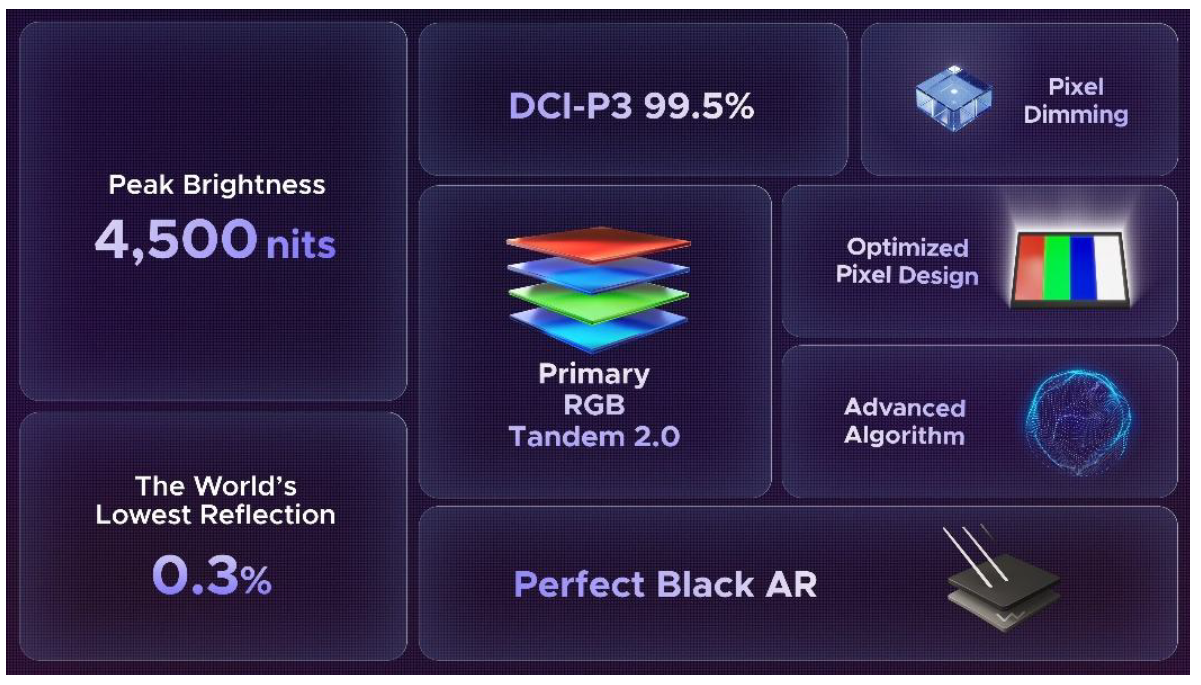
The ”WOLED” comes from an additional white light source, joining the usual RGB trio. “By precisely stacking RGB light sources in tandem, it creates pure white light and picture quality that nears perfection — blacks deepen, colors stay naturally true in any environment,” LG says. After seeing it in action, I have to say I agree!
OLED vs. Mini LED
LG drove home the point in several discrete demos comparing an “affordable” OLED TV against a rival mini LED television. Mini LED uses standard LCD technology, with roughly 1,500 “block-dimming” chunks spread across the screen; OLED can turn each of the 33 million+ pixels in a 4K display on and off independently.
It makes a huge difference. The mini LED still looked a lot better than most people’s TVs, but it suffered from color inaccuracy and other issues next to LG’s Tandem WOLED. Since mini LED (and all LCD panels) only dim colors in blocks, images can be affected by surrounding colors; you can witness “bloom” lightening effects around fireworks, and nearby colors affecting the look of people’s skin or supposedly white areas.
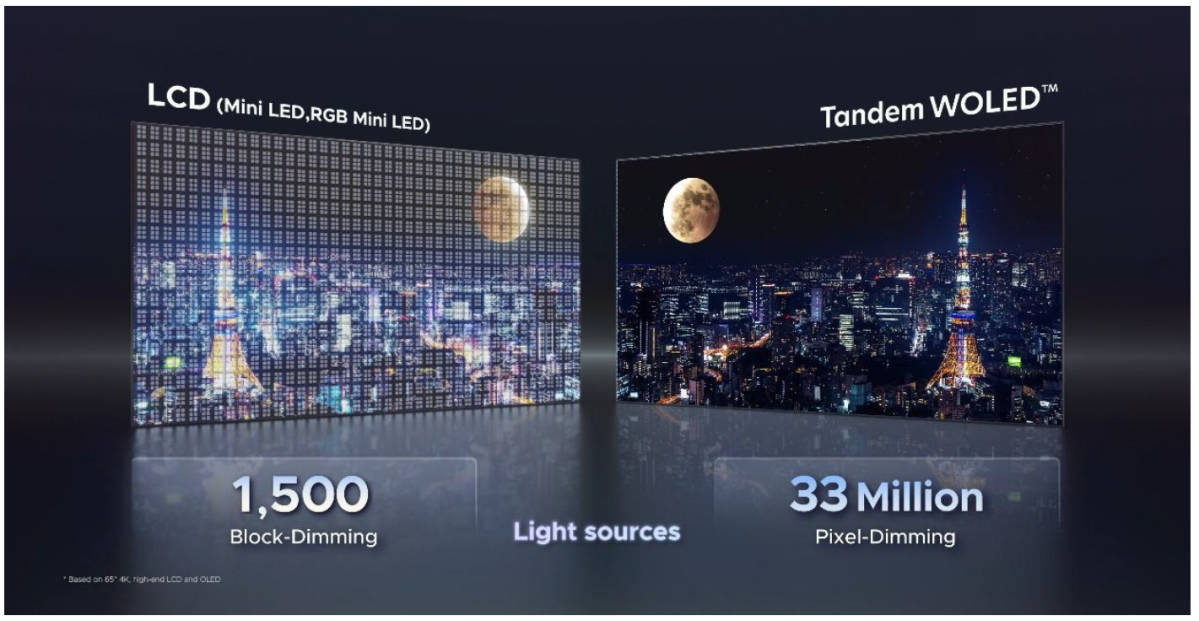
None of those appeared in LG’s Tandem WOLED panels. To be fair, these were mostly canned test demos to show extremes, but those extremes do happen, and the results largely aligned with my prior experiences with mini LED and LCD displays.
Sadly, I wasn’t able to capture convincing pictures of the comparison, since the visual nitpicks on the display can’t be captured by my camera. But trust me: You have to see it to believe it.
LG’s boundary-pushing OLED panels
At CES 2026, LG announced three boundary-pushing new Tandem WOLED panels to push the advantage.
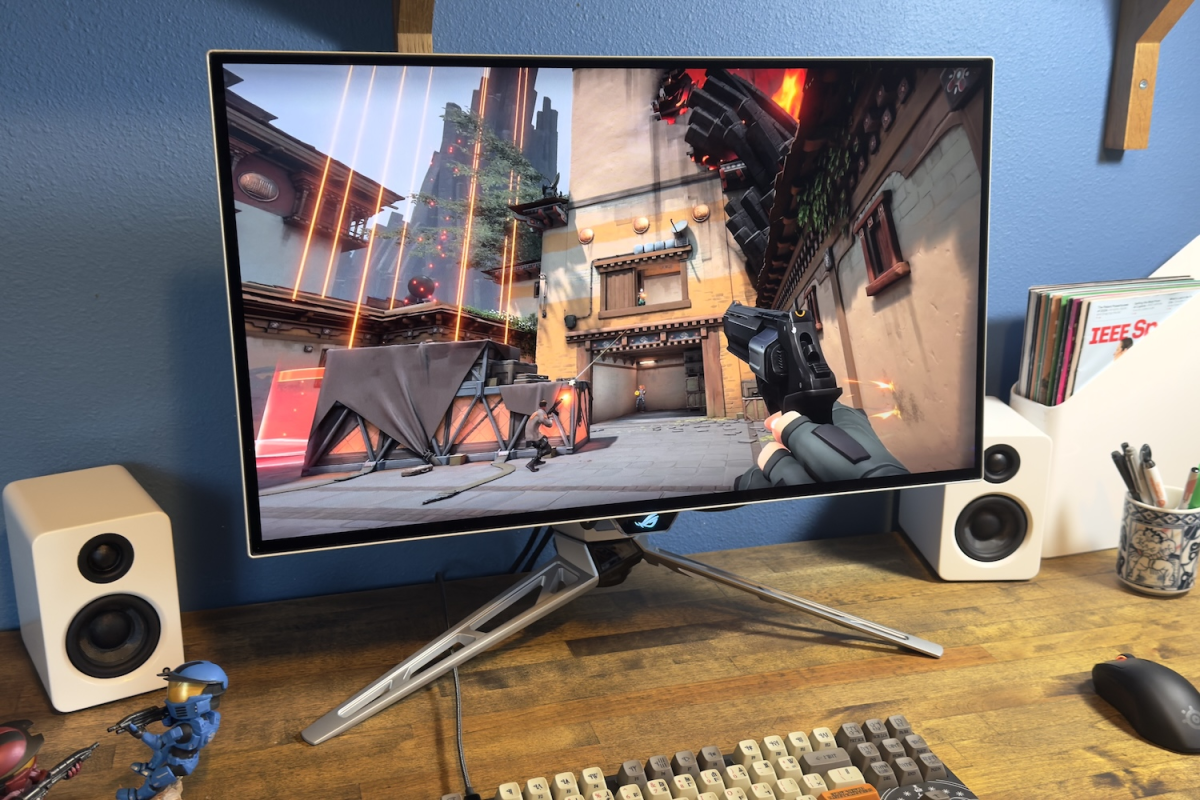
First, there’s a 27-inch gaming OLED capable of hitting a blistering 720HZ at 1080p resolution, or 540HZ at 1440p resolution — ludicrous speeds. This isn’t actually “new” though — the panel already debuted in Asus’ ROG Swift OLED PG27AQWP-W (pictured above) late last year, which knocked our socks off in our review. It earned 4.5 (out of 5) stars and an Editors’ Choice award.
“The Asus ROG Swift OLED PG27AQWP-W pulls out all the stops to deliver best-in-class motion performance and a long list of bonus features,” our synopsis says. Enough said! Well, not really — read our full review for a deeper look at the underlying tech, and how it handles in the ROG Swift.
World’s first OLED with a 240Hz RGB stripe pixel structure
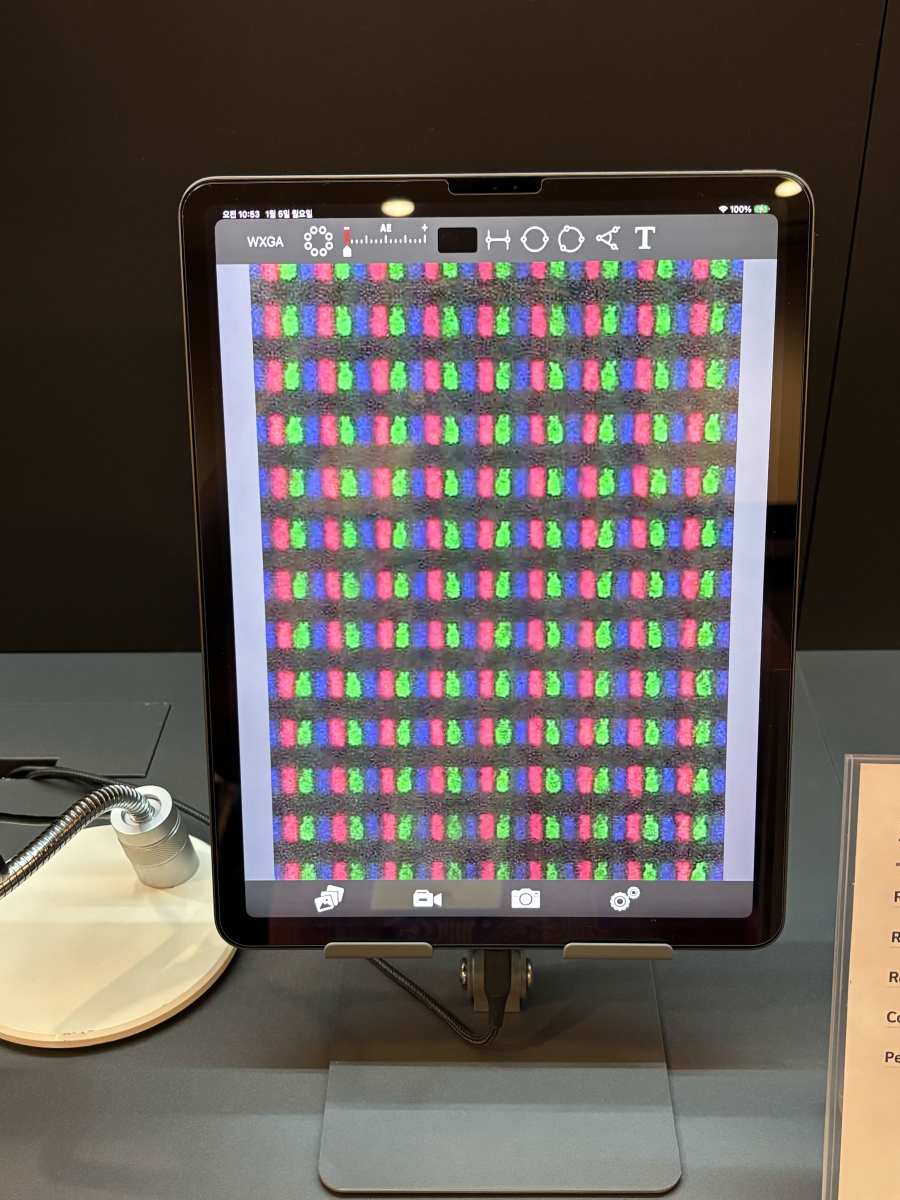
LG also showed off an OLED panel with the world’s first 240Hz RGB stripe pixel structure. “RGB stripe structure arranges the three primary color subpixels in a straight line, significantly reducing the visual distortions that can happen at close viewing distances,” LG’s press deck states. It “enables highly detailed and crisp graphic reproduction at 160 pixels per inch.”
That’s a lot of geek talk. Let me break it down for you.
OLED panels have a flaw that’s not always talked about. , the deep blacks and vivid colors look amazing while gaming or watching videos — but the technology often reproduces on-screen text less precisely. Called “fringing,” text on OLED monitors can sometimes appear somewhat blurry and distorted depending on the implementation. I covered this in-depth in my review of the Corsair Xeneon Flex (which used an LG OLED panel) in 2023, and you can see an example of text fringing from that very monitor below.

All those nerd words LG used to describe what “240Hz RGB stripe pixel structure” does basically say that text looks way less sucky. LG says this panel is “Optimized for operating systems such as Windows as well as font-rendering engines, ensuring excellent text readability and high color accuracy.”
LG showed off the monitor using a world-building game with lots of text, complete with a magnifier hooked up to the display to show how the RGB subpixel display looks IRL.
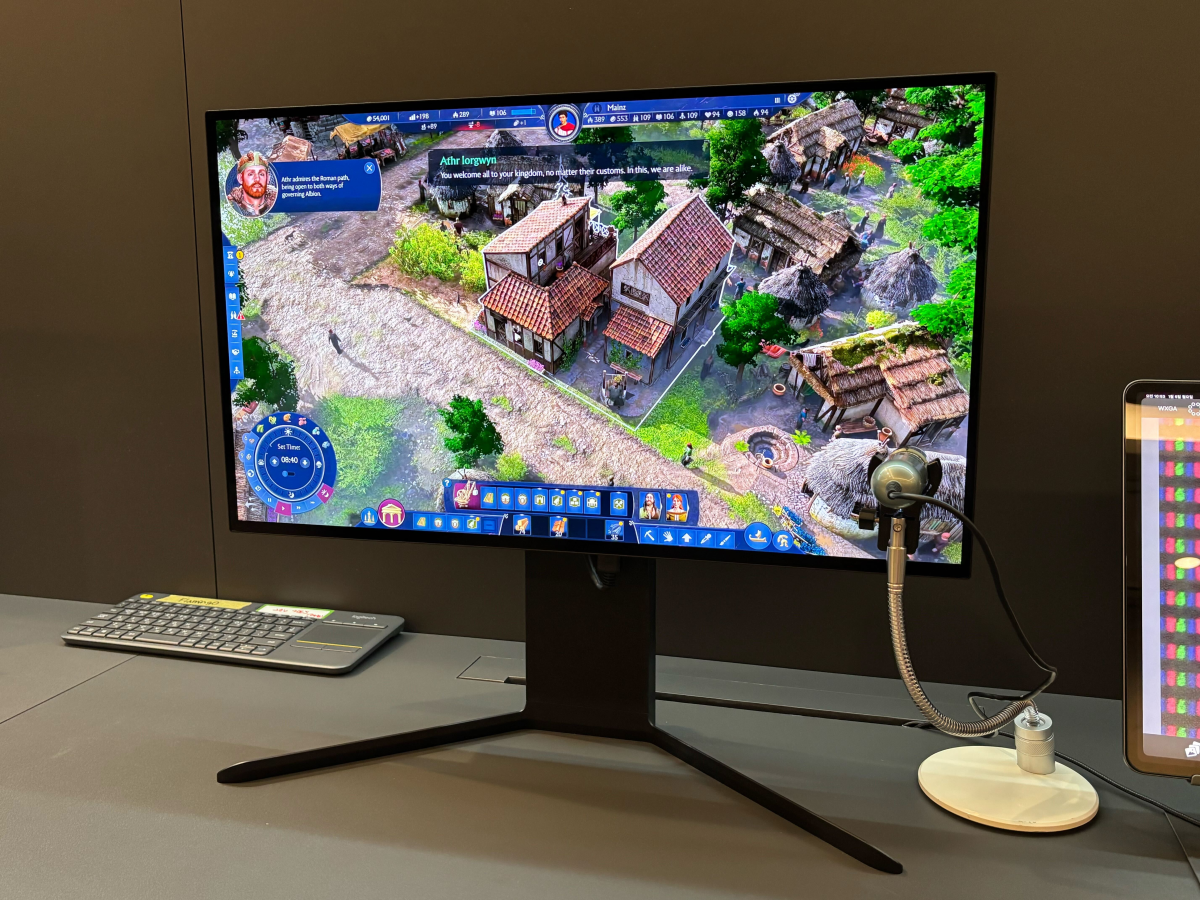
Fortunately, I was able to get a glimpse of a real world monitor with this panel over at Asus’ booth. Considering that Asus also helped debut those 720Hz/540Hz OLED monitors late last year, I guess Asus and LG are BFFs!
Here’s a picture of the just-announced Asus ROG Swift OLED PG27UCWM, using LG’s new panel. The system was fairly locked down but I was able to summon the right-click context menu to get a peek at the text fringing advancements, and welp, it looked significantly better than most rival OLEDs.
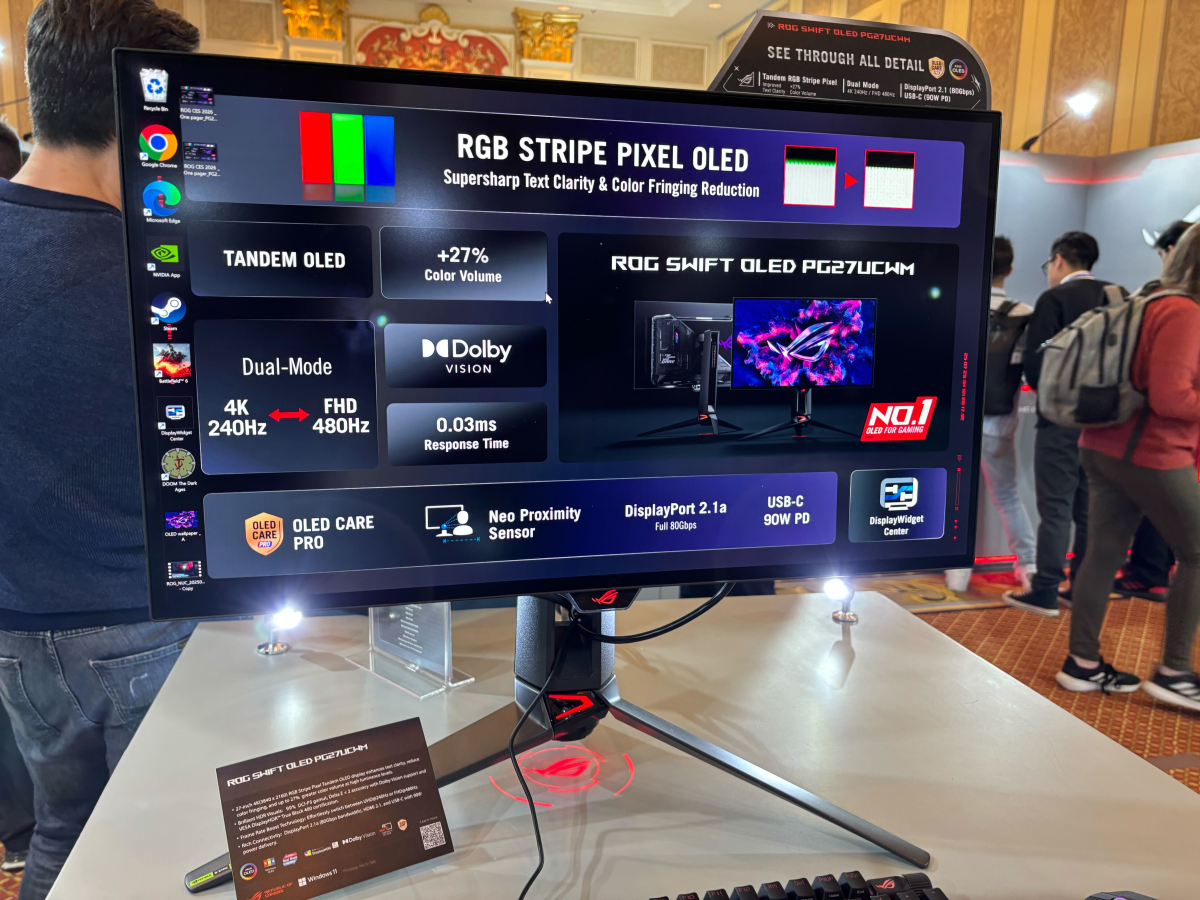

The panel uses LG’s Dynamic Frequency and Resolution (DFR) tech to run at 240Hz at 4K or 480Hz at 1080p. Look for monitors with this new panel to arrive sometime in Q2.
LG’s 39-inch ‘5K2K’ gaming OLED
4K? Ha! That’s so yesterday. Acer and LG are making 5K gaming monitors the hot new flex at CES 2026.
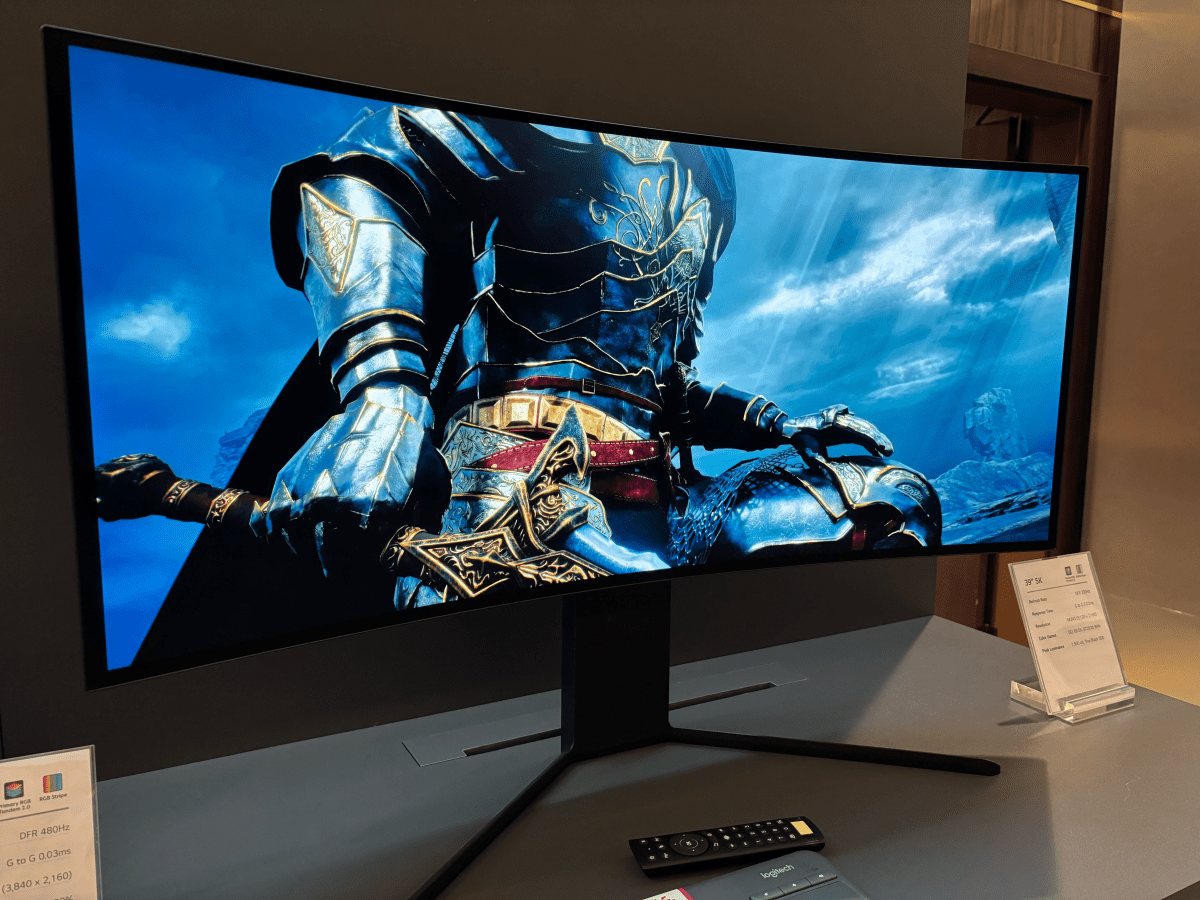
For LG, that means the introduction of the world’s first 39-inch 5K gaming OLED, with a standard 21:9 aspect ratio and 1500R curvature. There’s not really much more to say beyond that, but hot damn did it look luscious in real life — huge, wide, and utterly packed with high-quality OLED pixels galore.
Once these monitors launch in Q2, you’ll want to head down to a Best Buy or Microcenter to check them out with your own eyes — they’re that damned gorgeous. I’m willing to review one of these, just sayin’ LG.
Stay tuned to PCWorld (and our live blog) for all the hottest CES 2026 news all week long!
Author: Brad Chacos, Executive Editor, PCWorld

Brad Chacos spends his days digging through desktop PCs and tweeting too much. He specializes in graphics cards and gaming, but covers everything from security to Windows tips and all manner of PC hardware.
Recent stories by Brad Chacos:
Image: LG
One of the most exciting PC trends overall this decade is the rise of gorgeous OLED monitors. They’ve steadily improved year after year, delivering ever-more-luscious visuals at ever-increasing speeds, and during CES 2026, LG revealed a slew of new OLED panels designed to drive gaming fidelity even further.
Note that I said panels, not monitors; as a panel supplier, these LG displays will wind up in monitors from other vendors as well as LG’s own goodies.
And as a panel supplier, LG is doubling down on OLED. OLED has been under attack from the rise of RGB mini-LED panels that build upon existing LCD technology, for better or worse. LCD and OLED behave in very different ways, and LG’s new Tandem WOLED and Tandem OLED technologies (its first new OLED brands in 13 years!) push the advantage even further.
Tandem WOLED will appear in larger displays, like TVs and PC monitors, while Tandem OLED targets smaller devices like laptops, tablets, and automotive displays. I’m a thirsty, disgusting gamer so for this article, let’s focus on Tandem WOLED.
Officially called “Primary RGB Tandem 2.0,” Tandem WOLED can hit up to a whopping 4,500 nits in peak form, or 1,500 nits in PC monitors. A nit is equivalent to the brightness of a single candle, and we prefer that laptops hit 250 to 300 nits (or more) for optimal viewing, so that 1,500 nits is a big number — and one you can instantly feel and appreciate witnessing the technology in action. New “Perfect Black Anti-Reflection” tech “offers the world’s lowest reflectance of 0.3%,” ensuring a crisp picture even in bright conditions. Even better, Tandem WOLED supports 99.5% DCI-P3 coverage, an industry term that means its color accuracy is indeed insanely color accurate.
The ”WOLED” comes from an additional white light source, joining the usual RGB trio. “By precisely stacking RGB light sources in tandem, it creates pure white light and picture quality that nears perfection — blacks deepen, colors stay naturally true in any environment,” LG says. After seeing it in action, I have to say I agree!
OLED vs. Mini LED
LG drove home the point in several discrete demos comparing an “affordable” OLED TV against a rival mini LED television. Mini LED uses standard LCD technology, with roughly 1,500 “block-dimming” chunks spread across the screen; OLED can turn each of the 33 million+ pixels in a 4K display on and off independently.
It makes a huge difference. The mini LED still looked a lot better than most people’s TVs, but it suffered from color inaccuracy and other issues next to LG’s Tandem WOLED. Since mini LED (and all LCD panels) only dim colors in blocks, images can be affected by surrounding colors; you can witness “bloom” lightening effects around fireworks, and nearby colors affecting the look of people’s skin or supposedly white areas.
None of those appeared in LG’s Tandem WOLED panels. To be fair, these were mostly canned test demos to show extremes, but those extremes do happen, and the results largely aligned with my prior experiences with mini LED and LCD displays.
Sadly, I wasn’t able to capture convincing pictures of the comparison, since the visual nitpicks on the display can’t be captured by my camera. But trust me: You have to see it to believe it.
LG’s boundary-pushing OLED panels
At CES 2026, LG announced three boundary-pushing new Tandem WOLED panels to push the advantage.
First, there’s a 27-inch gaming OLED capable of hitting a blistering 720HZ at 1080p resolution, or 540HZ at 1440p resolution — ludicrous speeds. This isn’t actually “new” though — the panel already debuted in Asus’ ROG Swift OLED PG27AQWP-W (pictured above) late last year, which knocked our socks off in our review. It earned 4.5 (out of 5) stars and an Editors’ Choice award.
“The Asus ROG Swift OLED PG27AQWP-W pulls out all the stops to deliver best-in-class motion performance and a long list of bonus features,” our synopsis says. Enough said! Well, not really — read our full review for a deeper look at the underlying tech, and how it handles in the ROG Swift.
World’s first OLED with a 240Hz RGB stripe pixel structure
LG also showed off an OLED panel with the world’s first 240Hz RGB stripe pixel structure. “RGB stripe structure arranges the three primary color subpixels in a straight line, significantly reducing the visual distortions that can happen at close viewing distances,” LG’s press deck states. It “enables highly detailed and crisp graphic reproduction at 160 pixels per inch.”
That’s a lot of geek talk. Let me break it down for you.
OLED panels have a flaw that’s not always talked about.
, the deep blacks and vivid colors look amazing while gaming or watching videos — but the technology often reproduces on-screen text less precisely. Called “fringing,” text on OLED monitors can sometimes appear somewhat blurry and distorted depending on the implementation. I covered this in-depth in my review of the Corsair Xeneon Flex (which used an LG OLED panel) in 2023, and you can see an example of text fringing from that very monitor below.
All those nerd words LG used to describe what “240Hz RGB stripe pixel structure” does basically say that text looks way less sucky. LG says this panel is “Optimized for operating systems such as Windows as well as font-rendering engines, ensuring excellent text readability and high color accuracy.”
LG showed off the monitor using a world-building game with lots of text, complete with a magnifier hooked up to the display to show how the RGB subpixel display looks IRL.
Fortunately, I was able to get a glimpse of a real world monitor with this panel over at Asus’ booth. Considering that Asus also helped debut those 720Hz/540Hz OLED monitors late last year, I guess Asus and LG are BFFs!
Here’s a picture of the just-announced Asus ROG Swift OLED PG27UCWM, using LG’s new panel. The system was fairly locked down but I was able to summon the right-click context menu to get a peek at the text fringing advancements, and welp, it looked significantly better than most rival OLEDs.
The panel uses LG’s Dynamic Frequency and Resolution (DFR) tech to run at 240Hz at 4K or 480Hz at 1080p. Look for monitors with this new panel to arrive sometime in Q2.
LG’s 39-inch ‘5K2K’ gaming OLED
4K? Ha! That’s so yesterday. Acer and LG are making 5K gaming monitors the hot new flex at CES 2026.
For LG, that means the introduction of the world’s first 39-inch 5K gaming OLED, with a standard 21:9 aspect ratio and 1500R curvature. There’s not really much more to say beyond that, but hot damn did it look luscious in real life — huge, wide, and utterly packed with high-quality OLED pixels galore.
Once these monitors launch in Q2, you’ll want to head down to a Best Buy or Microcenter to check them out with your own eyes — they’re that damned gorgeous. I’m willing to review one of these, just sayin’ LG.
Stay tuned to PCWorld (and our live blog) for all the hottest CES 2026 news all week long!
Author: Brad Chacos, Executive Editor, PCWorld
Brad Chacos spends his days digging through desktop PCs and tweeting too much. He specializes in graphics cards and gaming, but covers everything from security to Windows tips and all manner of PC hardware.
Recent stories by Brad Chacos:
