


- Регистрация
- 17 Февраль 2018
- Сообщения
- 41 117
- Лучшие ответы
- 0
- Реакции
- 0
- Баллы
- 8 093
Offline
“We observed materially lower leak rates compared to prior observations during WDR-1.”
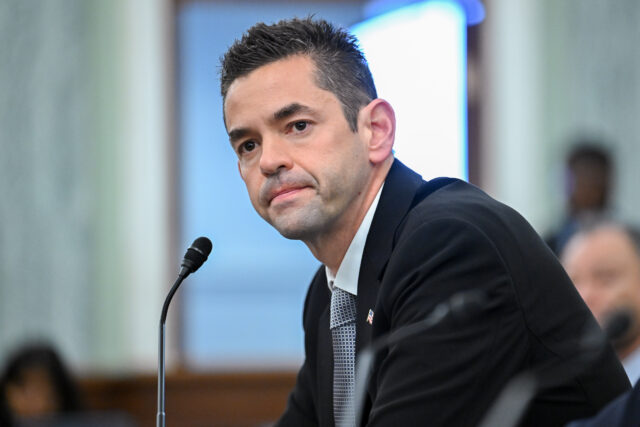
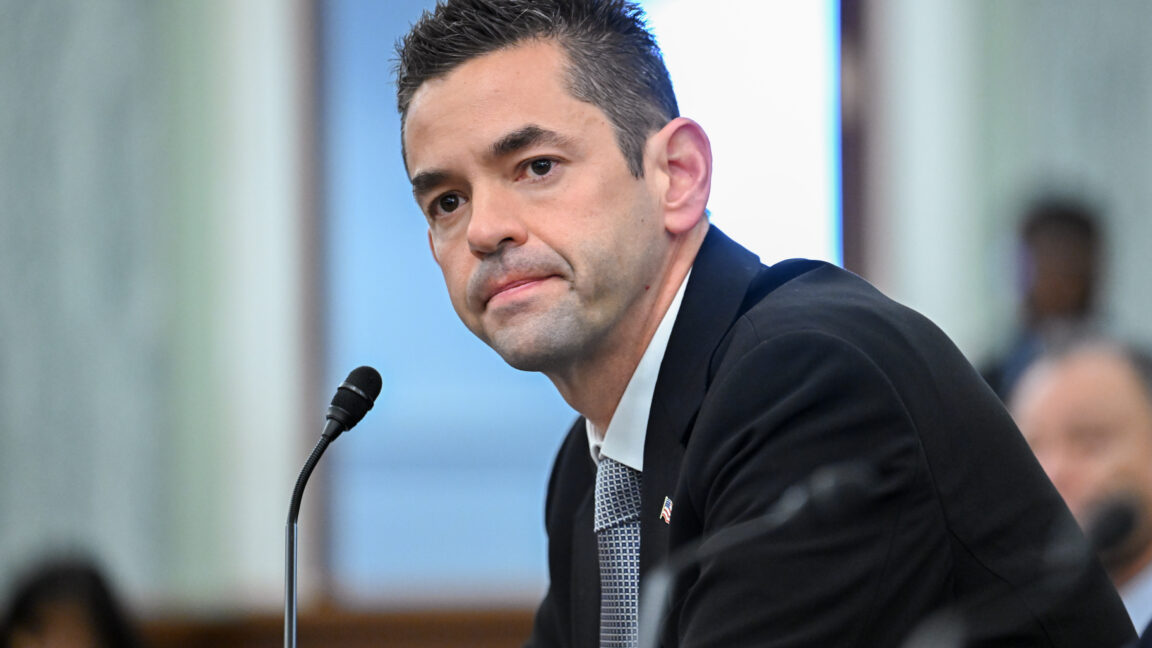
Jared Isaacman, NASA administrator, during a confirmation hearing before the Senate Commerce, Science, and Transportation Committee in Washington, DC, US, on December 3, 2025. Credit: Graeme Sloan/Bloomberg via Getty Images
NASA Administrator Jared Isaacman said Saturday the agency is looking at ways to prevent the fueling problems plaguing the Space Launch System rocket before the Artemis III mission.
Artemis III is slated to be the first crew mission to land on the Moon since the Apollo program more than 50 years ago. As for Artemis II, which remains on the launch pad at Kennedy Space Center in Florida after missing a launch window earlier this month, NASA is preparing for a second countdown rehearsal as soon as next week to confirm whether technicians have resolved a hydrogen fuel leak that cut short a practice countdown run February 2.
Artemis II is the first crew flight for SLS rocket and Orion spacecraft. The nearly 10-day mission will carry four astronauts around the far side of the Moon and return them to Earth.
Again and again
Fuel leaks are nothing new for the Space Launch System. The same kind of leak delayed the first test flight of the SLS rocket for several months in 2022. With that launch, ground teams thought they fixed the problem by changing how they load super-cold liquid hydrogen into the rocket’s core stage. The launch team used the same loading procedure February 2, but the leak cropped up again.
“Considering the issues observed during the lead-up to Artemis I, and the long duration between missions, we should not be surprised there are challenges entering the Artemis II campaign,” Isaacman wrote Saturday in an update on the social media site X. “That does not excuse the situation, but we understand it. I am impressed with the NASA team and our contractors working diligently through the campaign.”
Engineers traced the fueling issues to ground support equipment. Specifically, the hydrogen leaks originate in the area where fueling lines on the rocket’s launch platform connect to the bottom of the core stage. Two Tail Service Mast Umbilicals, or TSMUs, route liquid hydrogen and and liquid oxygen into the rocket during the countdown, then disconnect and retract into protective housings at liftoff.
The TSMU supplying liquid hydrogen to the core stage has two lines, 8 inches and 4 inches in diameter, connecting through matching umbilical plates on the ground side and the rocket side. Technicians replaced seals around the two fueling lines after the practice countdown, or Wet Dress Rehearsal (WDR), earlier this month.
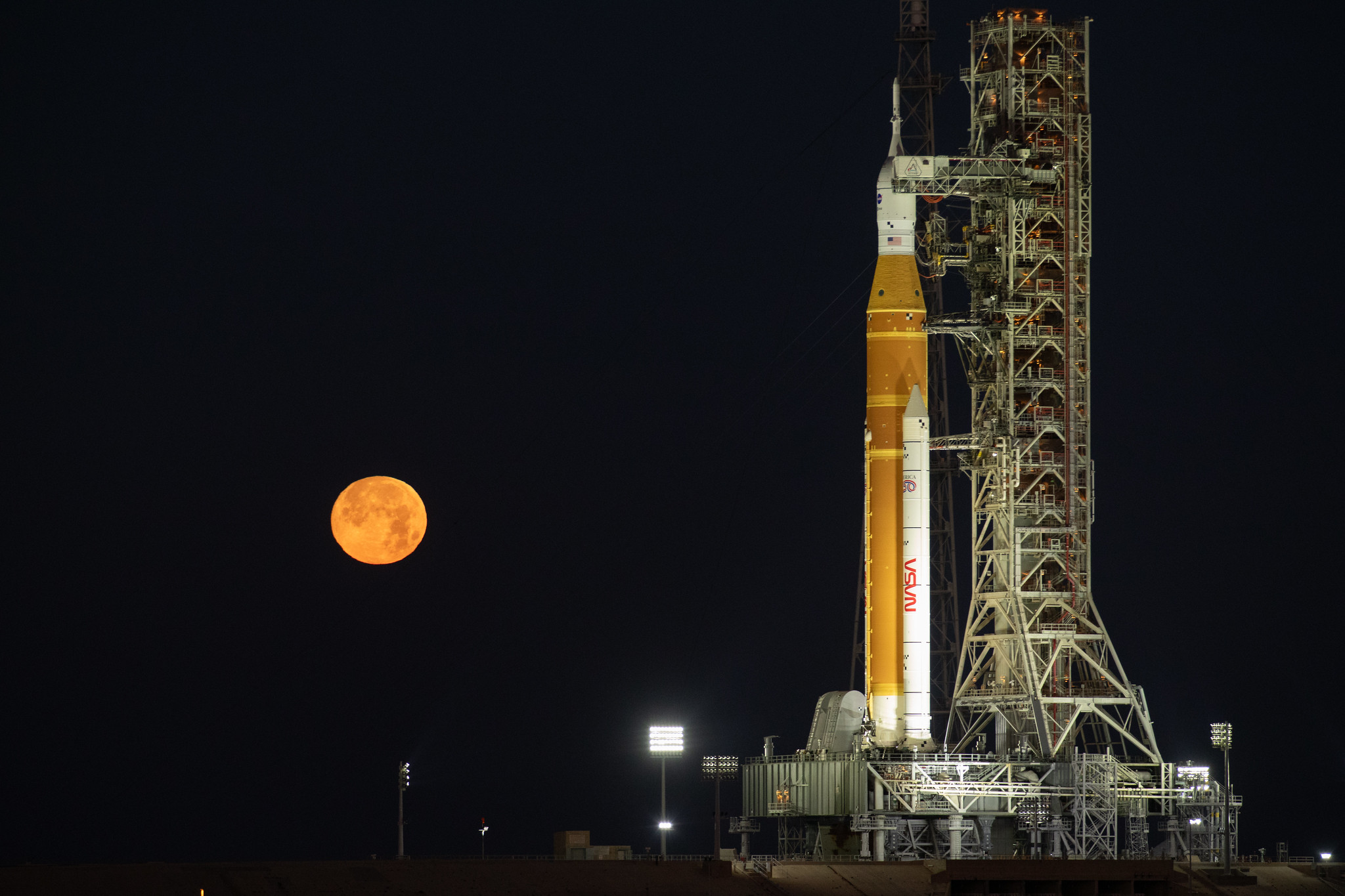
The full Moon is seen behind the Space Launch System rocket at NASA’s Kennedy Space Center in Florida. The Tail Service Mast Umbilicals (TSMUs) are the gray structures that extend above the launch platform on the bottom left of the core stage. Credit: NASA/Ben Smegelsky
On Thursday, NASA’s launch team tested the seals by partially filling the core stage with liquid hydrogen. This “confidence test” ended earlier than planned when the launch team encountered a new problem that reduced the flow of fuel into the rocket. In a statement released Friday night, NASA said workers will replace a filter suspected to be the cause of the reduced flow before proceeding into the next WDR.
The confidence test ended as the launch team transitioned to “fast fill” mode for liquid hydrogen, when pressures and flow rates put the finicky seals through the most stress. However, NASA said engineers achieved several key objectives of the confidence test.
Isaacman wrote Saturday that the test “provided a great deal of data, and we observed materially lower leak rates compared to prior observations during WDR-1.”
Although the launch team wasn’t able to test the seals in the most stressing conditions Thursday, officials apparently got enough data to move forward to the next WDR. During this upcoming test, NASA will attempt to fully load hydrogen and oxygen into the rocket and count down to less than a minute before launch, before stopping the clock and draining the SLS propellant tanks.
In his social media post, Isaacman characterized the outcome of Thursday’s confidence test this way: “I would not say something broke that caused the premature end to the test, as much as we observed enough and reached a point where waiting out additional troubleshooting was unnecessary.”
Changing the rules
During the first WDR earlier this month, hydrogen gas concentrations in the area around the fueling connection spiked higher than 16 percent, NASA’s safety limit. This spike was higher than any of the leak rates observed during the Artemis I launch campaign in 2022. Since then, NASA reassessed their safety limit and raised it from 4 percent—a conservative rule NASA held over from the Space Shuttle program—to 16 percent.
John Honeycutt, chair of NASA’s Artemis II mission management team, said the decision to relax the safety limit between Artemis I and Artemis II was grounded in test data.
“The SLS program, they came up with a test campaign that actually looked at that cavity, the characteristics of the cavity, the purge in the cavity … and they introduced hydrogen to see when you could actually get it to ignite, and at 16 percent, you could not,” said Honeycutt, who served as NASA’s SLS program manager before moving to his new job.
Hydrogen is explosive in high concentrations when mixed with air. This is what makes hydrogen a formidable rocket fuel. But it is also notoriously difficult to contain. Molecular hydrogen is the smallest molecule, meaning it can readily escape through leak paths, and poses a materials challenge for seals because liquified hydrogen is chilled to minus 423 degrees Fahrenheit (minus 253 degrees Celsius).
So, it turns out NASA used the three-year interim between Artemis I and Artemis II to get comfortable with a more significant hydrogen leak, instead of fixing the leaks themselves. Isaacman said that will change before Artemis III, which likewise is probably at least three years away.
“I will say near-conclusively for Artemis III, we will cryoproof the vehicle before it gets to the pad, and the propellant loading interfaces we are troubleshooting will be redesigned,” Isaacman wrote.
Isaacman took over as NASA’s administrator in December, and has criticized the SLS program’s high cost—estimated by NASA’s inspector general at more than $2 billion per rocket—along with the launch vehicle’s torpid flight rate.
NASA’s expenditures for the rocket’s ground systems at Kennedy Space Center are similarly enormous. NASA spent nearly $900 million on Artemis ground support infrastructure in 2024 alone. Much of the money went toward constructing a new launch platform for an upgraded version of the Space Launch System that may never fly.
All of this makes each SLS rocket a golden egg, a bespoke specimen that must be treated with care because it is too expensive to replace. NASA and Boeing, the prime contractor for the SLS core stage, never built a full-size test model of the core stage. There’s currently no way to completely test the cryogenic interplay between the core stage and ground equipment until the fully assembled rocket is on the launch pad.
Existing law requires NASA continue flying the SLS rocket through the Artemis V mission. Isaacman wrote that the Artemis architecture “will continue to evolve as we learn more and as industry capabilities mature.” In other words, NASA will incorporate newer, cheaper, reusable rockets into the Artemis program.
The next series of launch opportunities for the Artemis II mission begin March 3. If the mission doesn’t lift off in March, NASA will need to roll the rocket back to the Vehicle Assembly Building to refresh its flight termination system. There are more launch dates available in April and May.
“There is still a great deal of work ahead to prepare for this historic mission,” Isaacman wrote. “We will not launch unless we are ready and the safety of our astronauts will remain the highest priority. We will keep everyone informed as NASA prepares to return to the Moon.”
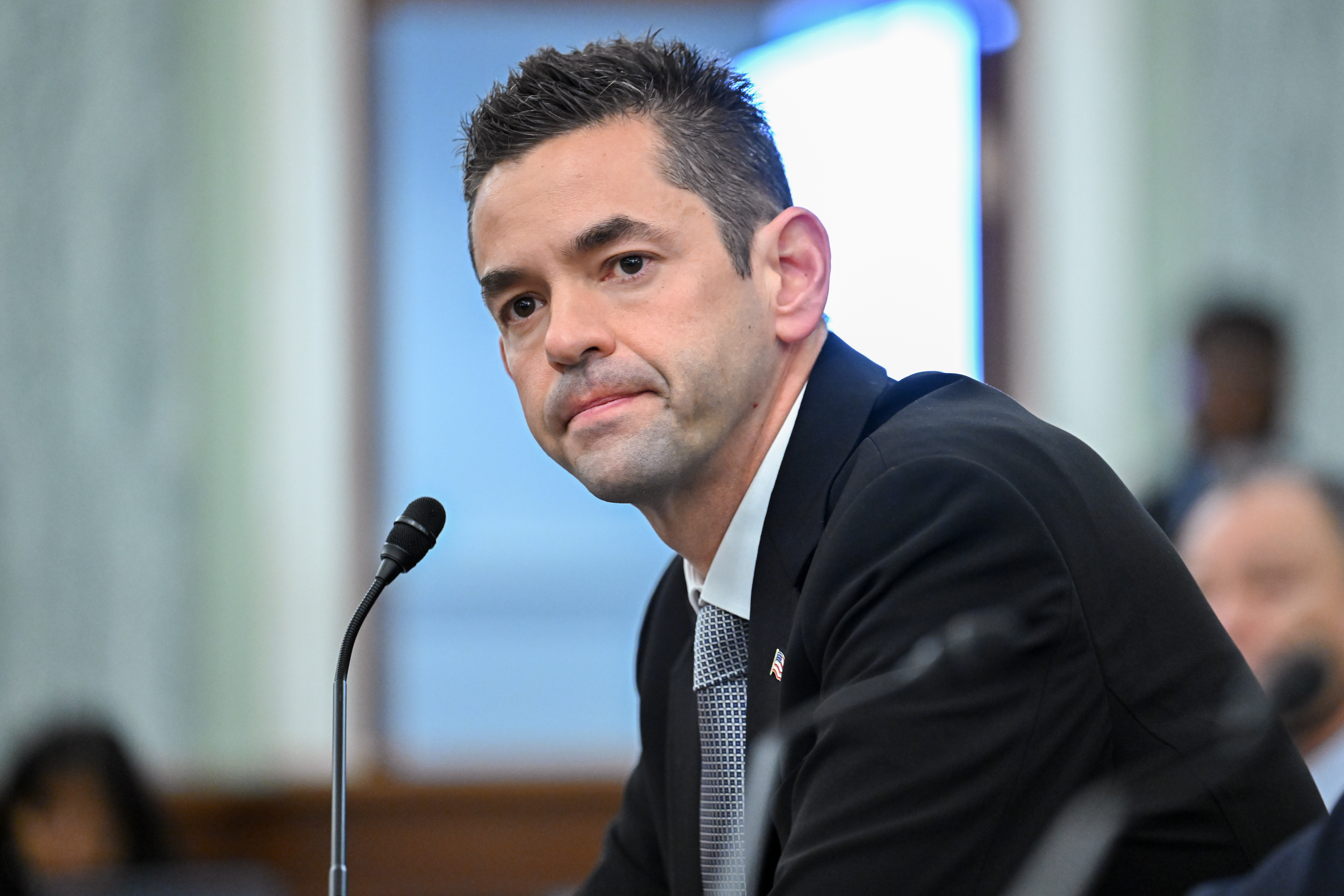
Jared Isaacman, NASA administrator, during a confirmation hearing before the Senate Commerce, Science, and Transportation Committee in Washington, DC, US, on December 3, 2025. Credit: Graeme Sloan/Bloomberg via Getty Images
NASA Administrator Jared Isaacman said Saturday the agency is looking at ways to prevent the fueling problems plaguing the Space Launch System rocket before the Artemis III mission.
Artemis III is slated to be the first crew mission to land on the Moon since the Apollo program more than 50 years ago. As for Artemis II, which remains on the launch pad at Kennedy Space Center in Florida after missing a launch window earlier this month, NASA is preparing for a second countdown rehearsal as soon as next week to confirm whether technicians have resolved a hydrogen fuel leak that cut short a practice countdown run February 2.
Artemis II is the first crew flight for SLS rocket and Orion spacecraft. The nearly 10-day mission will carry four astronauts around the far side of the Moon and return them to Earth.
Again and again
Fuel leaks are nothing new for the Space Launch System. The same kind of leak delayed the first test flight of the SLS rocket for several months in 2022. With that launch, ground teams thought they fixed the problem by changing how they load super-cold liquid hydrogen into the rocket’s core stage. The launch team used the same loading procedure February 2, but the leak cropped up again.
“Considering the issues observed during the lead-up to Artemis I, and the long duration between missions, we should not be surprised there are challenges entering the Artemis II campaign,” Isaacman wrote Saturday in an update on the social media site X. “That does not excuse the situation, but we understand it. I am impressed with the NASA team and our contractors working diligently through the campaign.”
Engineers traced the fueling issues to ground support equipment. Specifically, the hydrogen leaks originate in the area where fueling lines on the rocket’s launch platform connect to the bottom of the core stage. Two Tail Service Mast Umbilicals, or TSMUs, route liquid hydrogen and and liquid oxygen into the rocket during the countdown, then disconnect and retract into protective housings at liftoff.
The TSMU supplying liquid hydrogen to the core stage has two lines, 8 inches and 4 inches in diameter, connecting through matching umbilical plates on the ground side and the rocket side. Technicians replaced seals around the two fueling lines after the practice countdown, or Wet Dress Rehearsal (WDR), earlier this month.
The full Moon is seen behind the Space Launch System rocket at NASA’s Kennedy Space Center in Florida. The Tail Service Mast Umbilicals (TSMUs) are the gray structures that extend above the launch platform on the bottom left of the core stage. Credit: NASA/Ben Smegelsky
On Thursday, NASA’s launch team tested the seals by partially filling the core stage with liquid hydrogen. This “confidence test” ended earlier than planned when the launch team encountered a new problem that reduced the flow of fuel into the rocket. In a statement released Friday night, NASA said workers will replace a filter suspected to be the cause of the reduced flow before proceeding into the next WDR.
The confidence test ended as the launch team transitioned to “fast fill” mode for liquid hydrogen, when pressures and flow rates put the finicky seals through the most stress. However, NASA said engineers achieved several key objectives of the confidence test.
Isaacman wrote Saturday that the test “provided a great deal of data, and we observed materially lower leak rates compared to prior observations during WDR-1.”
Although the launch team wasn’t able to test the seals in the most stressing conditions Thursday, officials apparently got enough data to move forward to the next WDR. During this upcoming test, NASA will attempt to fully load hydrogen and oxygen into the rocket and count down to less than a minute before launch, before stopping the clock and draining the SLS propellant tanks.
In his social media post, Isaacman characterized the outcome of Thursday’s confidence test this way: “I would not say something broke that caused the premature end to the test, as much as we observed enough and reached a point where waiting out additional troubleshooting was unnecessary.”
Changing the rules
During the first WDR earlier this month, hydrogen gas concentrations in the area around the fueling connection spiked higher than 16 percent, NASA’s safety limit. This spike was higher than any of the leak rates observed during the Artemis I launch campaign in 2022. Since then, NASA reassessed their safety limit and raised it from 4 percent—a conservative rule NASA held over from the Space Shuttle program—to 16 percent.
John Honeycutt, chair of NASA’s Artemis II mission management team, said the decision to relax the safety limit between Artemis I and Artemis II was grounded in test data.
“The SLS program, they came up with a test campaign that actually looked at that cavity, the characteristics of the cavity, the purge in the cavity … and they introduced hydrogen to see when you could actually get it to ignite, and at 16 percent, you could not,” said Honeycutt, who served as NASA’s SLS program manager before moving to his new job.
Hydrogen is explosive in high concentrations when mixed with air. This is what makes hydrogen a formidable rocket fuel. But it is also notoriously difficult to contain. Molecular hydrogen is the smallest molecule, meaning it can readily escape through leak paths, and poses a materials challenge for seals because liquified hydrogen is chilled to minus 423 degrees Fahrenheit (minus 253 degrees Celsius).
So, it turns out NASA used the three-year interim between Artemis I and Artemis II to get comfortable with a more significant hydrogen leak, instead of fixing the leaks themselves. Isaacman said that will change before Artemis III, which likewise is probably at least three years away.
“I will say near-conclusively for Artemis III, we will cryoproof the vehicle before it gets to the pad, and the propellant loading interfaces we are troubleshooting will be redesigned,” Isaacman wrote.
Isaacman took over as NASA’s administrator in December, and has criticized the SLS program’s high cost—estimated by NASA’s inspector general at more than $2 billion per rocket—along with the launch vehicle’s torpid flight rate.
NASA’s expenditures for the rocket’s ground systems at Kennedy Space Center are similarly enormous. NASA spent nearly $900 million on Artemis ground support infrastructure in 2024 alone. Much of the money went toward constructing a new launch platform for an upgraded version of the Space Launch System that may never fly.
All of this makes each SLS rocket a golden egg, a bespoke specimen that must be treated with care because it is too expensive to replace. NASA and Boeing, the prime contractor for the SLS core stage, never built a full-size test model of the core stage. There’s currently no way to completely test the cryogenic interplay between the core stage and ground equipment until the fully assembled rocket is on the launch pad.
Existing law requires NASA continue flying the SLS rocket through the Artemis V mission. Isaacman wrote that the Artemis architecture “will continue to evolve as we learn more and as industry capabilities mature.” In other words, NASA will incorporate newer, cheaper, reusable rockets into the Artemis program.
The next series of launch opportunities for the Artemis II mission begin March 3. If the mission doesn’t lift off in March, NASA will need to roll the rocket back to the Vehicle Assembly Building to refresh its flight termination system. There are more launch dates available in April and May.
“There is still a great deal of work ahead to prepare for this historic mission,” Isaacman wrote. “We will not launch unless we are ready and the safety of our astronauts will remain the highest priority. We will keep everyone informed as NASA prepares to return to the Moon.”
