


- Регистрация
- 17 Февраль 2018
- Сообщения
- 40 832
- Лучшие ответы
- 0
- Реакции
- 0
- Баллы
- 8 093
Offline
“There’s very little to not like in this.”

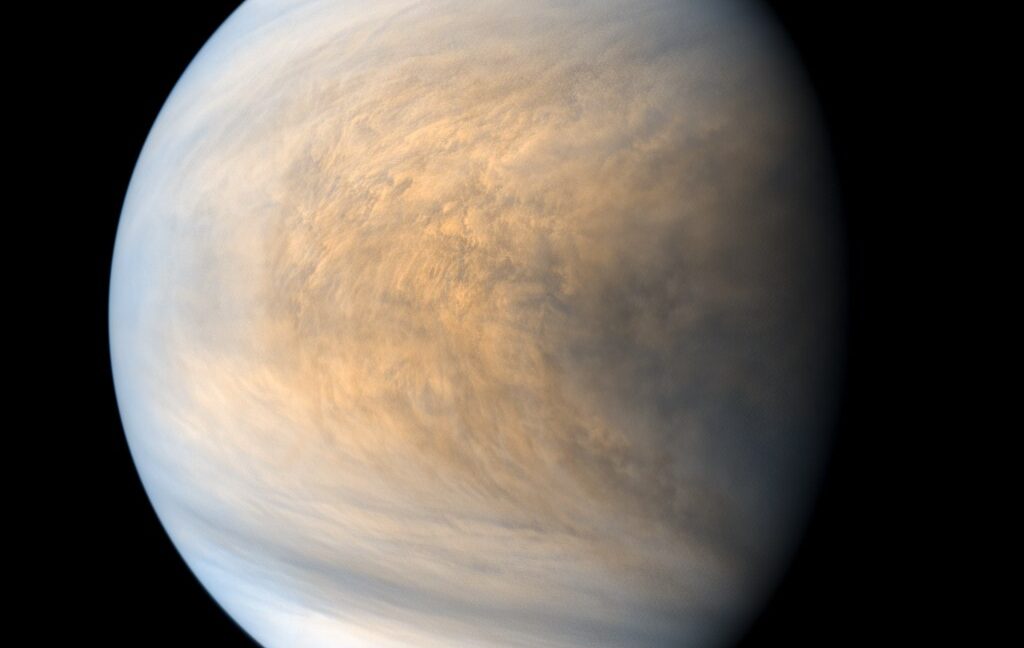
A mission to explore Venus is back on the agenda. Credit: JAXA/ISAS/DARTS/Kevin M. Gill
In June, the White House released a budget proposal for fiscal year 2026 that slashed funding for NASA’s science programs by nearly 50 percent. Then, in July, the Trump administration began telling the leaders of dozens of space science missions to prepare “closeout” plans for their spacecraft.
Things looked pretty grim for a while, but then Congress stepped in. Congress, of course, sets the federal government’s budget. In many ways, Congress abdicated authority to the Trump administration last year. But not so, it turns out, with federal spending.
Throughout the summer and fall, as the White House and Congress wrangled over various issues, lawmakers made it clear they intended to fund most of NASA’s science portfolio. Preliminary efforts to shut down active missions were put on hold.
On Monday, Congress made good on those promises, releasing a $24.4 billion budget plan for NASA as part of the conferencing process, when House and Senate lawmakers convene to hammer out a final budget. The result is a budget that calls for just a 1 percent cut in NASA’s science funding, to $7.25 billion, for fiscal year 2026.
Better than could be hoped for
“This is, frankly, better than I could have expected,” said Casey Dreier, chief of space policy for The Planetary Society, which argued against the cuts. “There’s very little to not like in this.”
The new budget will not undo the significant cuts to NASA’s workforce through a voluntary buyout program in 2025, or other efforts by the Trump administration and the Department of Government Efficiency to reduce headcounts across the federal government.
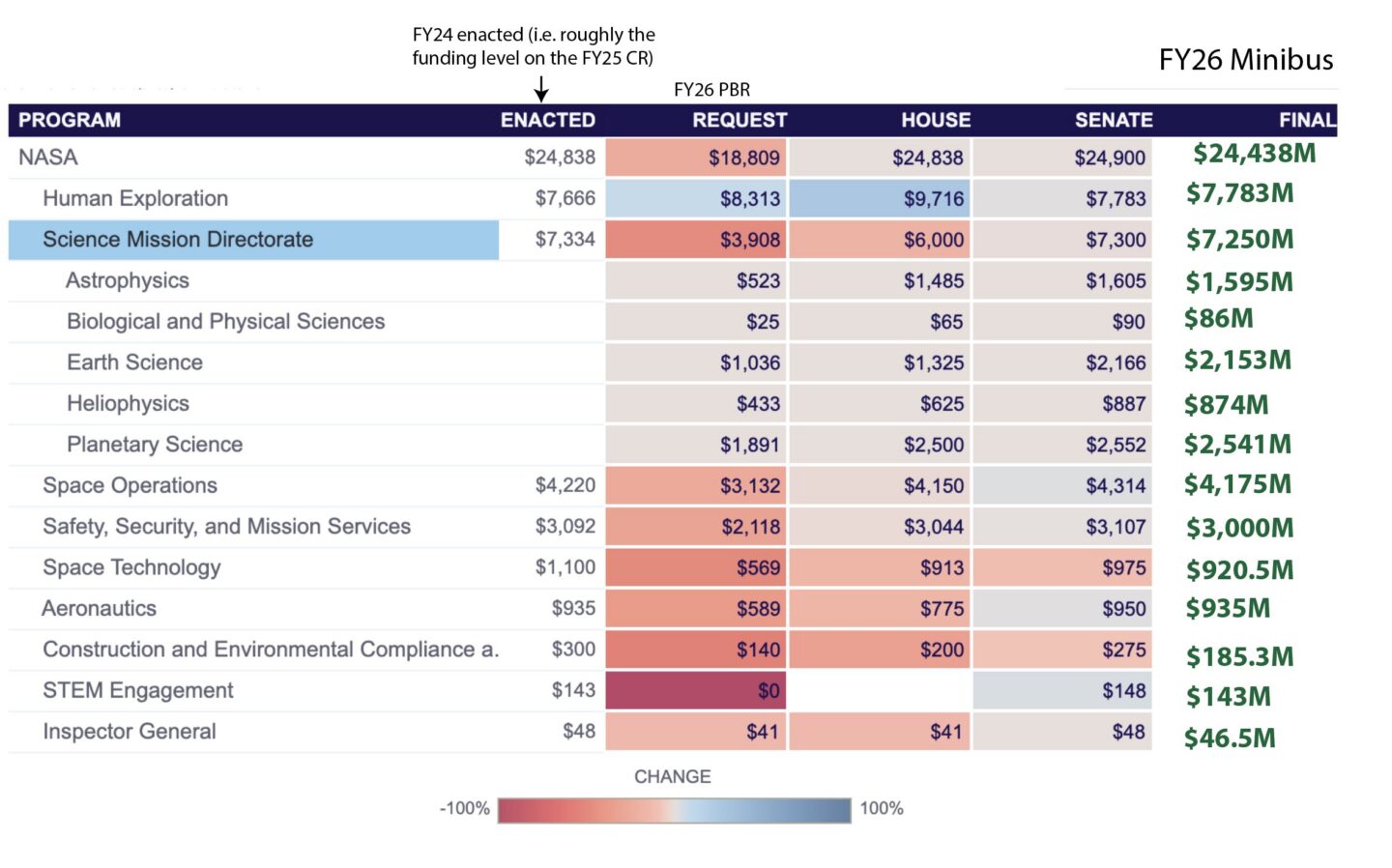
Summary of budget changes from what President Trump requested (PBR) through to the final numbers. Credit: Grant Tremblay, X
Dreier also lamented the many wasted hours spent planning by scientists and engineers to comply with the Trump White House’s budget proposal.
“Those hours could have been spent running and analyzing data from these valuable missions,” Dreier said. “It created a lot of needless friction and churn at a time when NASA is being told it must remain competitive with China and other nations in space.”
Budget likely to be signed soon
The House of Representatives could vote on the budget bill for Commerce, Justice, Science, and Related Agencies as soon as this week, with the US Senate possibly following next week. It is expected that President Trump will sign the bill. It would then go into effect immediately for the current fiscal year, which began on October 1.
The biggest casualty in the NASA science budget is the Mars Sample Return mission, a NASA-led effort to return Martian rocks and soil for study in Earth-based laboratories.
“As proposed in the budget, the agreement does not support the existing Mars Sample Return (MSR) program,” the budget document states. “However, the technological capabilities being developed in the MSR program are not only critical to the success of future science missions but also to human exploration of the Moon and Mars.”
Although it offers no details, the budget provides $110 million for something called the “Mars Future Missions” program to support “radar, spectroscopy, entry, descent, and landing systems.”
Some hope for future missions, too
NASA previously said it was pausing the ambitious sample return mission because its projected cost was approximately $10 billion, with no certain return date for the samples.
Now it seems likely that the agency and its new administrator, Jared Isaacman, will have to develop a new strategy. This may include sending humans to Mars, rather than bringing Martian rocks back to Earth.
Unlike the Trump budget request, the science budget also keeps future missions, such as the DAVINCI probe for Venus, alive. It also provides $10 million to continue studying the development of a Uranus orbiter, as well as $150 million for a flagship telescope to search for signs of life on nearby, Earth-like planets called the Habitable Worlds Observatory.

A mission to explore Venus is back on the agenda. Credit: JAXA/ISAS/DARTS/Kevin M. Gill
In June, the White House released a budget proposal for fiscal year 2026 that slashed funding for NASA’s science programs by nearly 50 percent. Then, in July, the Trump administration began telling the leaders of dozens of space science missions to prepare “closeout” plans for their spacecraft.
Things looked pretty grim for a while, but then Congress stepped in. Congress, of course, sets the federal government’s budget. In many ways, Congress abdicated authority to the Trump administration last year. But not so, it turns out, with federal spending.
Throughout the summer and fall, as the White House and Congress wrangled over various issues, lawmakers made it clear they intended to fund most of NASA’s science portfolio. Preliminary efforts to shut down active missions were put on hold.
On Monday, Congress made good on those promises, releasing a $24.4 billion budget plan for NASA as part of the conferencing process, when House and Senate lawmakers convene to hammer out a final budget. The result is a budget that calls for just a 1 percent cut in NASA’s science funding, to $7.25 billion, for fiscal year 2026.
Better than could be hoped for
“This is, frankly, better than I could have expected,” said Casey Dreier, chief of space policy for The Planetary Society, which argued against the cuts. “There’s very little to not like in this.”
The new budget will not undo the significant cuts to NASA’s workforce through a voluntary buyout program in 2025, or other efforts by the Trump administration and the Department of Government Efficiency to reduce headcounts across the federal government.
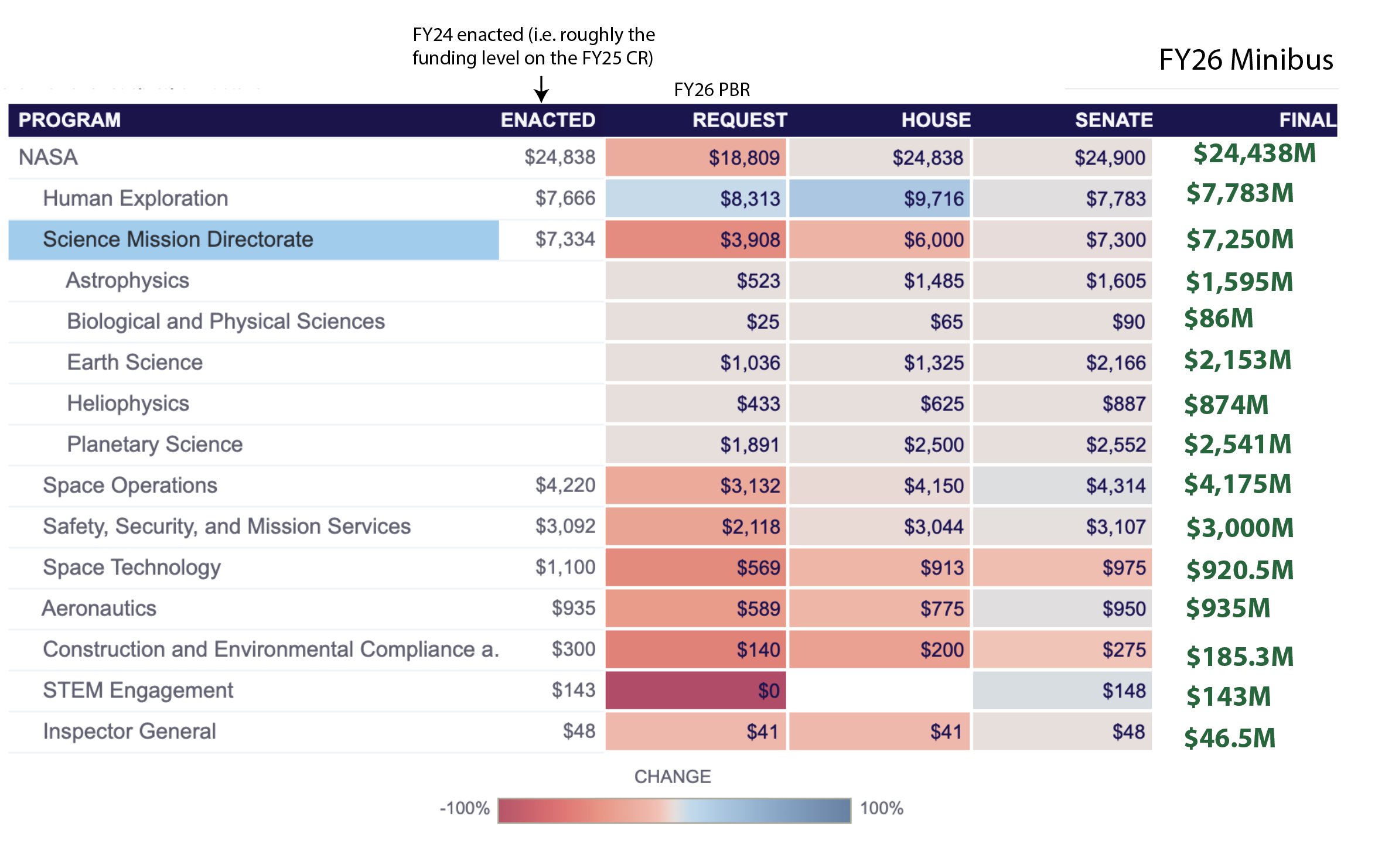
Summary of budget changes from what President Trump requested (PBR) through to the final numbers. Credit: Grant Tremblay, X
Dreier also lamented the many wasted hours spent planning by scientists and engineers to comply with the Trump White House’s budget proposal.
“Those hours could have been spent running and analyzing data from these valuable missions,” Dreier said. “It created a lot of needless friction and churn at a time when NASA is being told it must remain competitive with China and other nations in space.”
Budget likely to be signed soon
The House of Representatives could vote on the budget bill for Commerce, Justice, Science, and Related Agencies as soon as this week, with the US Senate possibly following next week. It is expected that President Trump will sign the bill. It would then go into effect immediately for the current fiscal year, which began on October 1.
The biggest casualty in the NASA science budget is the Mars Sample Return mission, a NASA-led effort to return Martian rocks and soil for study in Earth-based laboratories.
“As proposed in the budget, the agreement does not support the existing Mars Sample Return (MSR) program,” the budget document states. “However, the technological capabilities being developed in the MSR program are not only critical to the success of future science missions but also to human exploration of the Moon and Mars.”
Although it offers no details, the budget provides $110 million for something called the “Mars Future Missions” program to support “radar, spectroscopy, entry, descent, and landing systems.”
Some hope for future missions, too
NASA previously said it was pausing the ambitious sample return mission because its projected cost was approximately $10 billion, with no certain return date for the samples.
Now it seems likely that the agency and its new administrator, Jared Isaacman, will have to develop a new strategy. This may include sending humans to Mars, rather than bringing Martian rocks back to Earth.
Unlike the Trump budget request, the science budget also keeps future missions, such as the DAVINCI probe for Venus, alive. It also provides $10 million to continue studying the development of a Uranus orbiter, as well as $150 million for a flagship telescope to search for signs of life on nearby, Earth-like planets called the Habitable Worlds Observatory.
