


- Регистрация
- 17 Февраль 2018
- Сообщения
- 40 830
- Лучшие ответы
- 0
- Реакции
- 0
- Баллы
- 8 093
Offline
The tradeoffs for the $499 9850X3D make it hard to get excited about.
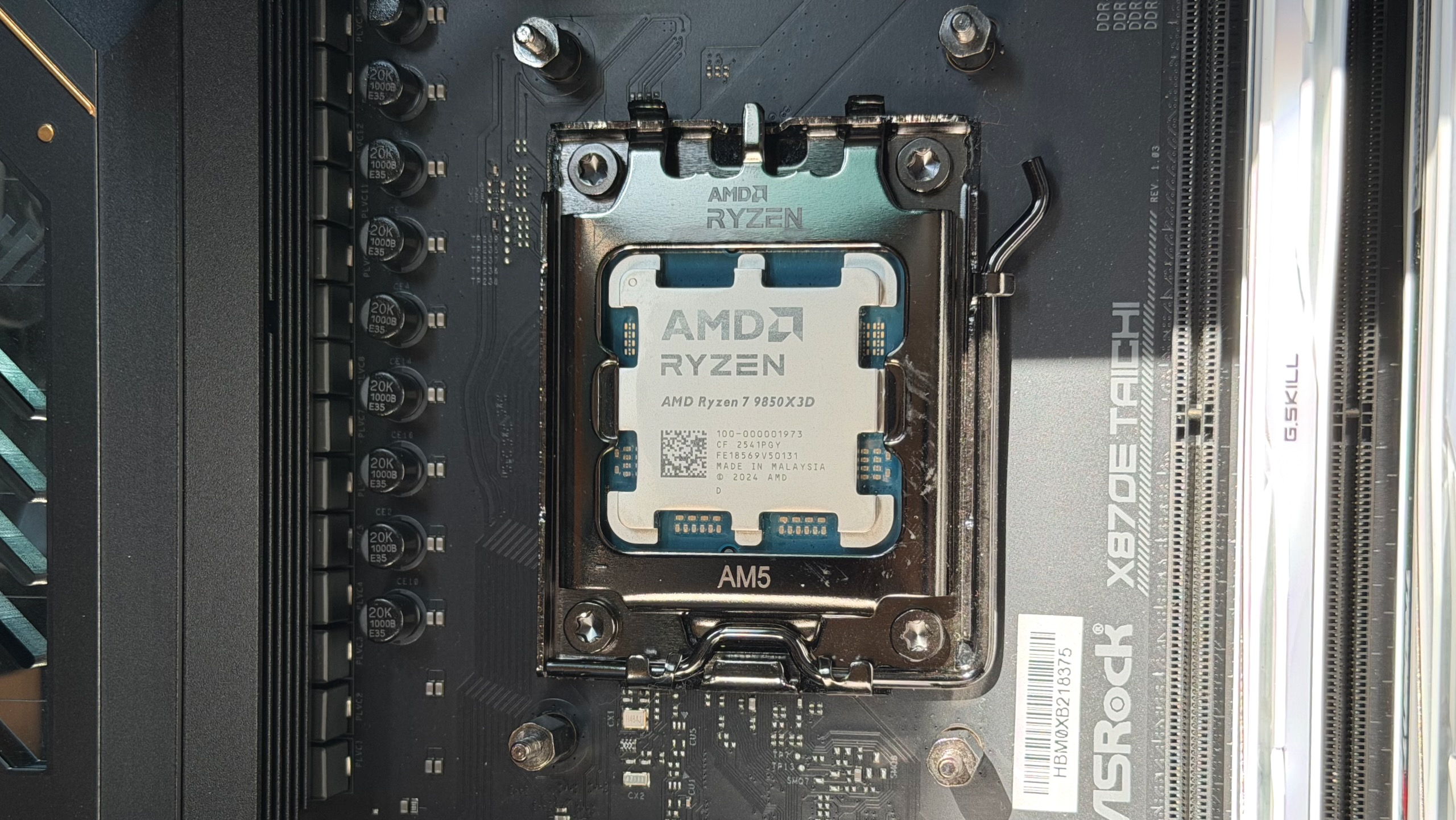
AMD's Ryzen 7 9850X3D. Credit: Andrew Cunningham
AMD has released three distinct generations of its 3D V-Cache technology, which initially appeared in the Ryzen 7 5800X3D in 2022. The kernel of the idea has remained the same throughout AMD’s efforts: take an existing desktop processor design and graft 64MB of additional L3 cache onto it.
This approach disproportionately helps apps that benefit from more cache, particularly games, and the size of the boost that 3D V-Cache gives to game performance has always been enough to offset any downsides these chips have come with. In the four years since the 5800X3D was released, AMD also has steadily chipped away at those disadvantages, adding more CPU cores, improving power consumption and temperatures, and re-adding the typical Ryzen range of overclocking controls.
AMD’s new Ryzen 7 9850X3D, which launches for $499 starting tomorrow, is the very definition of a mild upgrade. It’s the year-old Ryzen 7 9800X3D but with an extra 400 MHz of turbo boost speed. That’s it. That’s the chip.
But it is mildly interesting that the 9800X3D’s 5.6GHz boost clock is now 100 MHz higher than that of the Ryzen 7 9700X, the chip’s nearest non-V-Cache equivalent. It’s not nearly as interesting as an actual new chip, but it does mean AMD has closed the last major functional gap between the V-Cache and non-V-Cache Ryzen chips (the pricing gap remains; the 9700X currently retails for around $329).
It also means that the 9850X3D behaves more like a 9700X in other ways—differences that likely won’t matter to its target audience but which do distinguish it from being “just a faster 9800X3D.”
Chip recap
The biggest change AMD made to the Ryzen 9000 version of the X3D chips is that the 3D V-Cache is now stacked underneath the CPU silicon rather than on top. This has the benefit of moving the CPU cores closer to your heatsink or AIO loop, making them easier to keep cool.
The 9850X3D remains an eight-core chip based on AMD’s Zen 5 architecture. All eight of those CPU cores have access to the 3D V-Cache, unlike the 12-core and 16-core Ryzen 9 9900X3D and 9950X3D. In each of those chips, one of the CPU chiplets has access to the 3D V-Cache and one doesn’t; AMD’s chipset software is responsible for making sure apps run on the type of CPU core that will maximize the app’s performance. AMD’s software is pretty good at this, but it’s not foolproof, which can make the 9800X3D and 9850X3D more appealing and cost-effective options for PCs that will mainly be used for gaming.
The specs in our CPU testbed are the same as they’ve been for a while. We’ll be focused on comparing the 9850X3D to its predecessors, the 5800X3D, 7800X3D, and 9800X3D, as well as the non-V-Cache 7700X and 9700X. We’ll also include numbers from the higher-end 9900X3D and 9950X3D. Intel’s side of the fence will be represented by the Core Ultra 9 285K and the last few generations of Core i9 chips, though Intel has yet to release any chips that are truly performance-competitive with the 3D V-Cache chips in gaming workloads.
Though our testbed continues to rely on DDR5-6000, AMD’s slide deck takes the current (horrible) state of the RAM market into account. While DDR5-6000 or DDR5-6400 is generally still the performance sweet spot for all socket AM5 CPUs, AMD notes that game performance between the 9850X3D with DDR5-6000 and the same chip with DDR5-4800 can be as little as 1 to 2 percent. In other words, pair whatever RAM you can find with this chip and don’t worry about it too much.
Performance and power consumption
The first thing to notice about the 9850X3D is that its multi-core performance is essentially indistinguishable from the 9800X3D. If anything, the 9800X3D seems marginally better behaved in our Handbrake video encoding tests, which could come down to anything or nothing—maybe it’s an actual difference between the chips, maybe it’s the silicon lottery, maybe it’s something else. Overall, it’s mostly a wash.
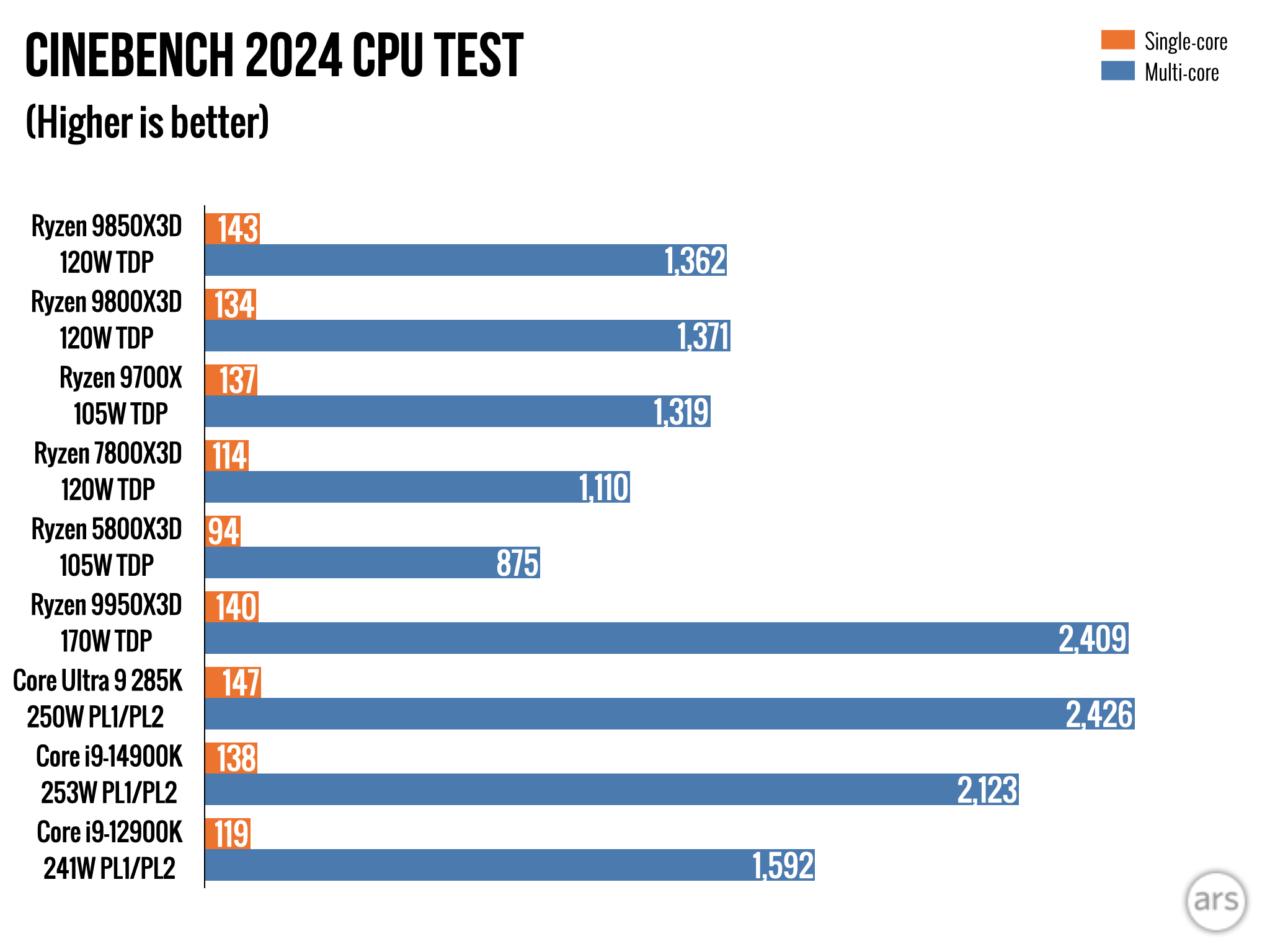
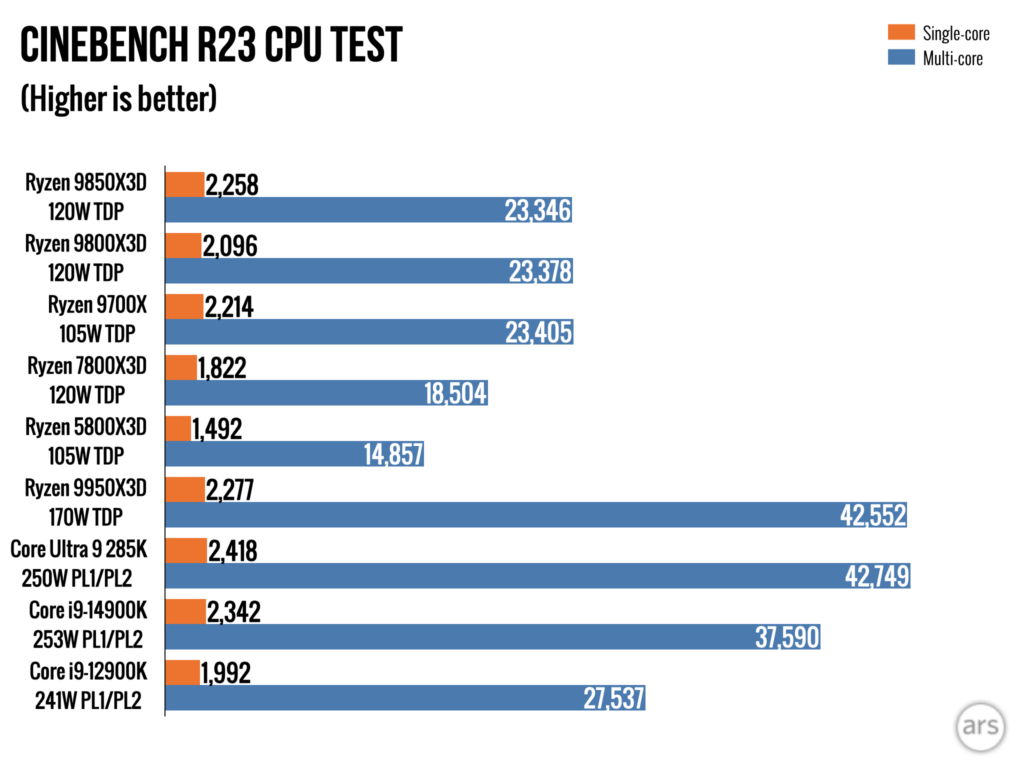
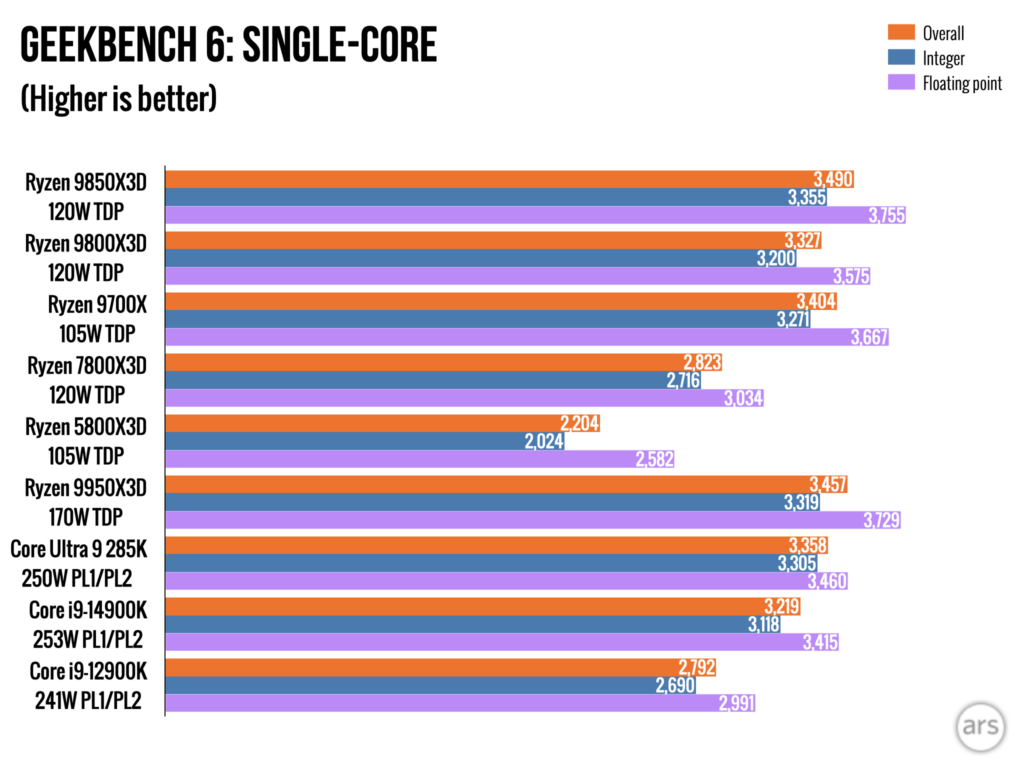
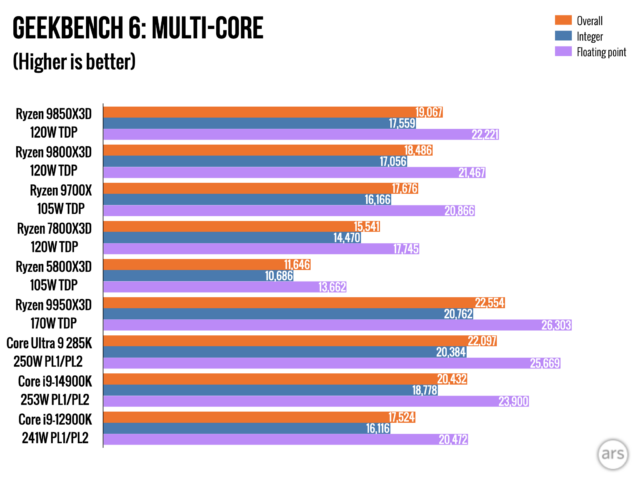
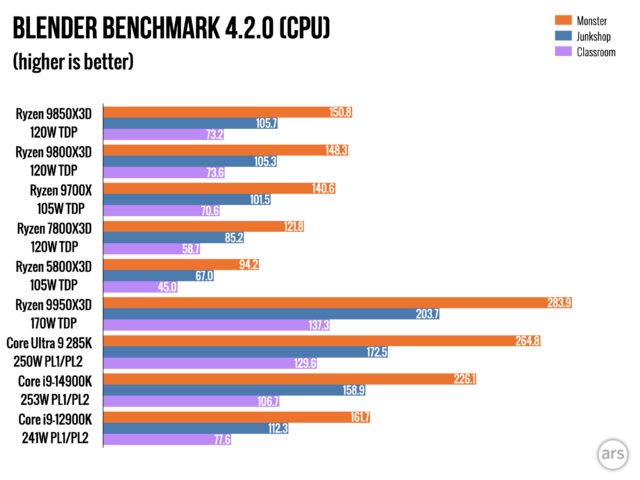
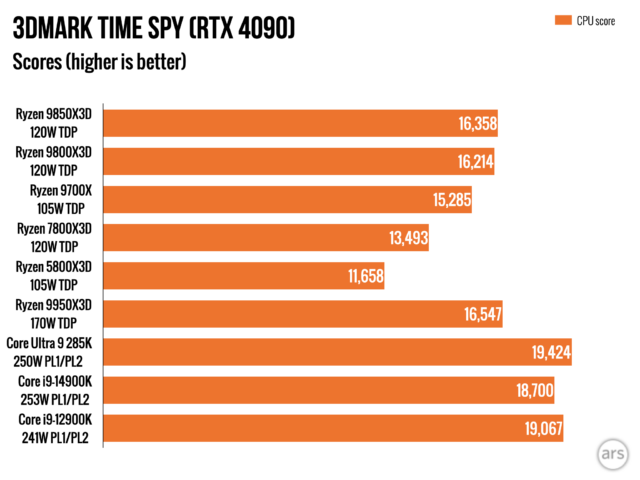
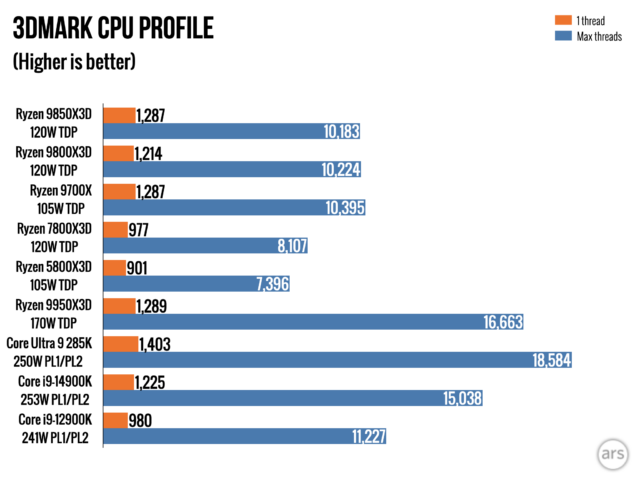
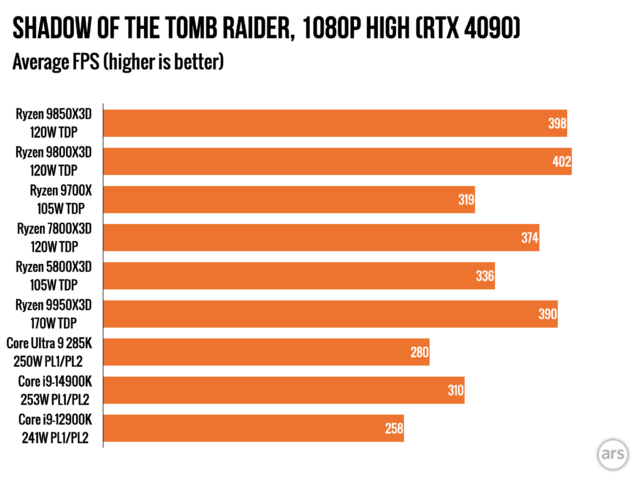
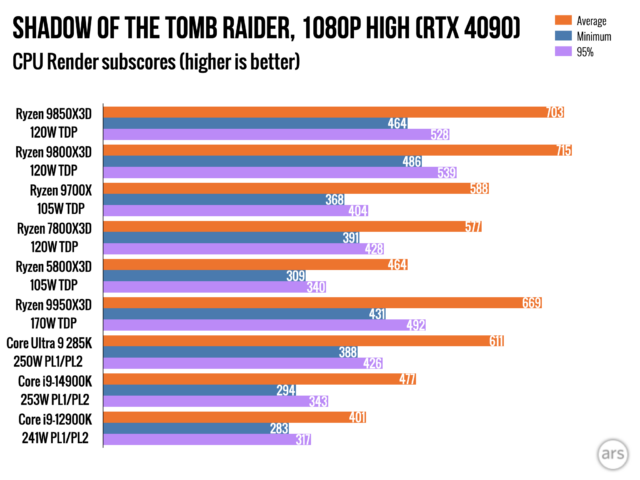
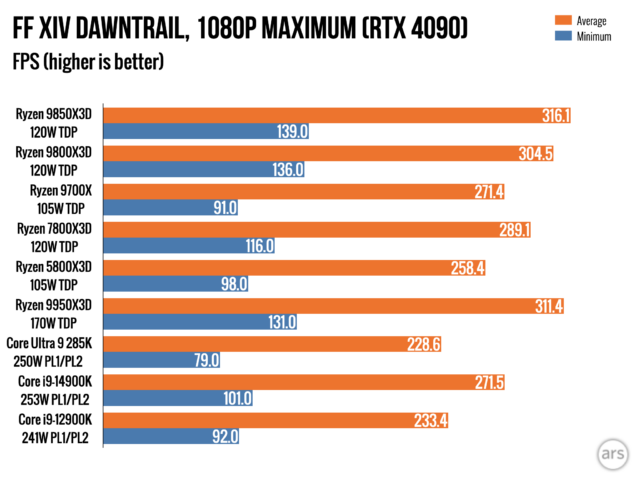
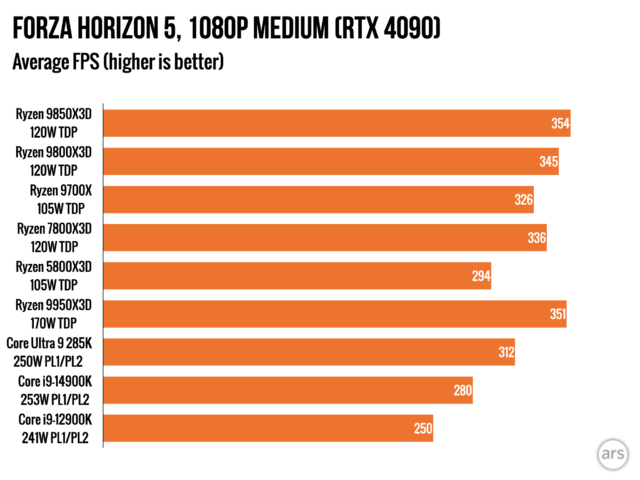
The 9850X3D does improve significantly on the 9800X3D’s single-core performance, closing the gap with both the Ryzen 9900X3D and 9950X3D (both of which have regular Zen 5 cores with no 3D V-Cache) and the 9700X (which has no 3D V-Cache at all).
There’s a world in which AMD can get this extra performance for “free” without changing anything about the architecture or manufacturing process. AMD could have been “binning” silicon lottery winners, or the reliability of the manufacturing process could have improved enough to allow AMD to hit better numbers that weren’t as consistently achievable a year ago.
But it looks like AMD improved the 9850X3D’s single-core performance mainly by making it behave more like a non-X3D chip. The chip’s power consumption while gaming suggests this is more or less what’s happening—the 9850X3D’s CPU package power while gaming is some 25 or 30 W higher than the 9800X3D playing the same games, despite the single-digit-at-best performance improvement (in both our testing and AMD’s advertising).
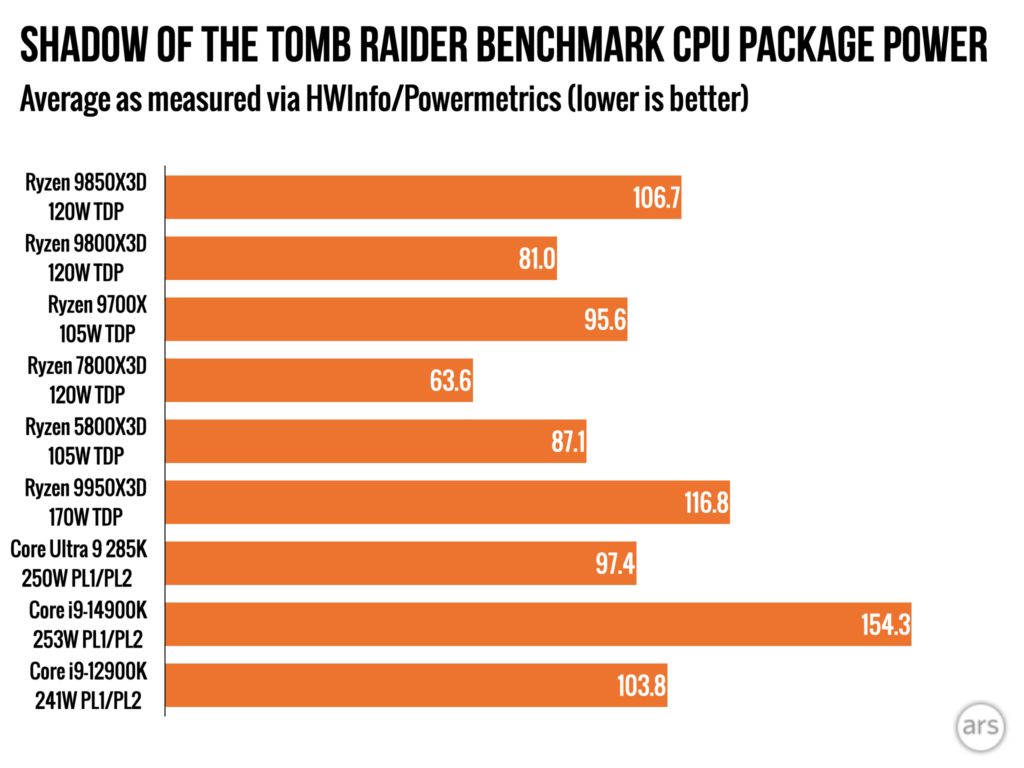
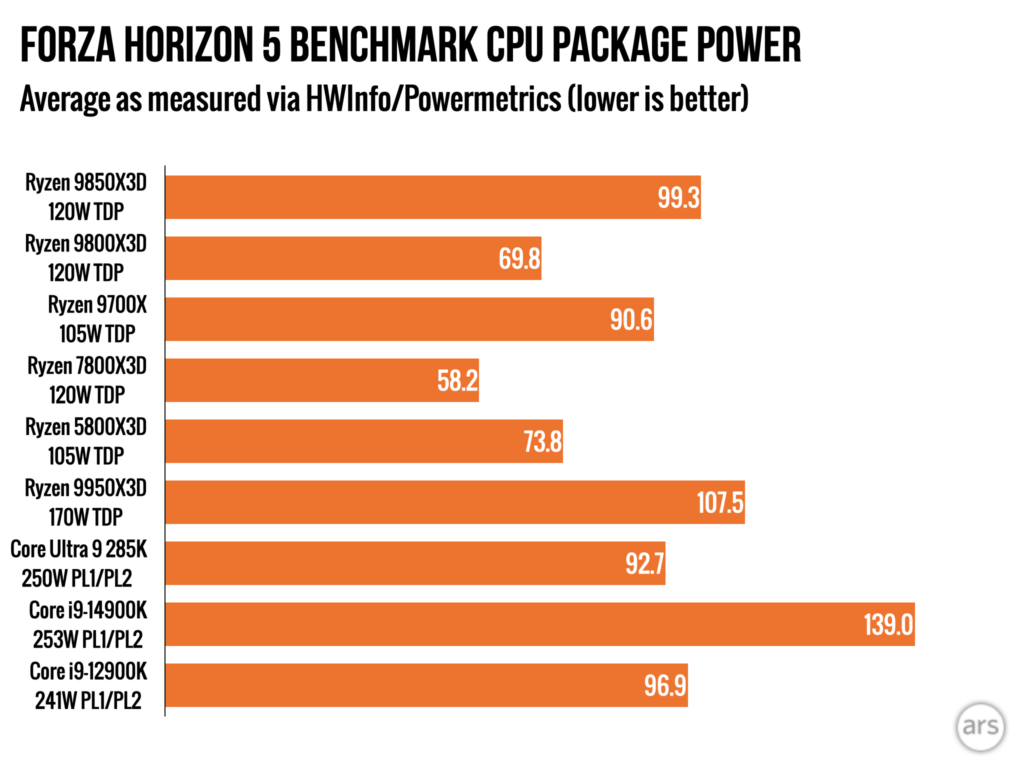
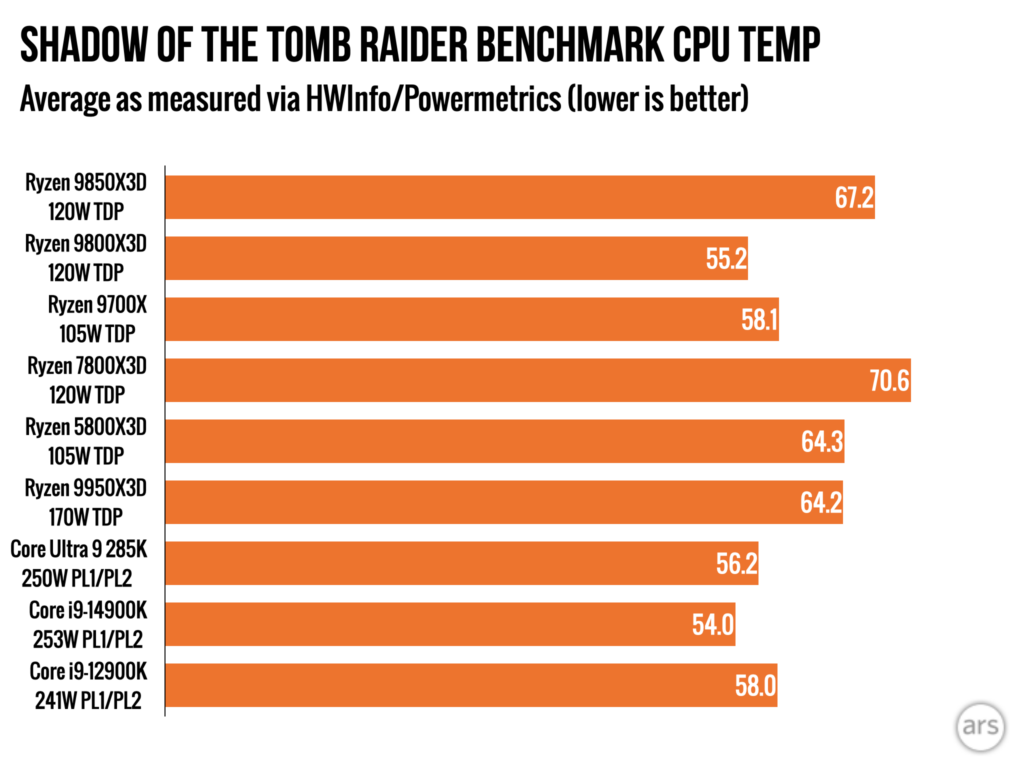
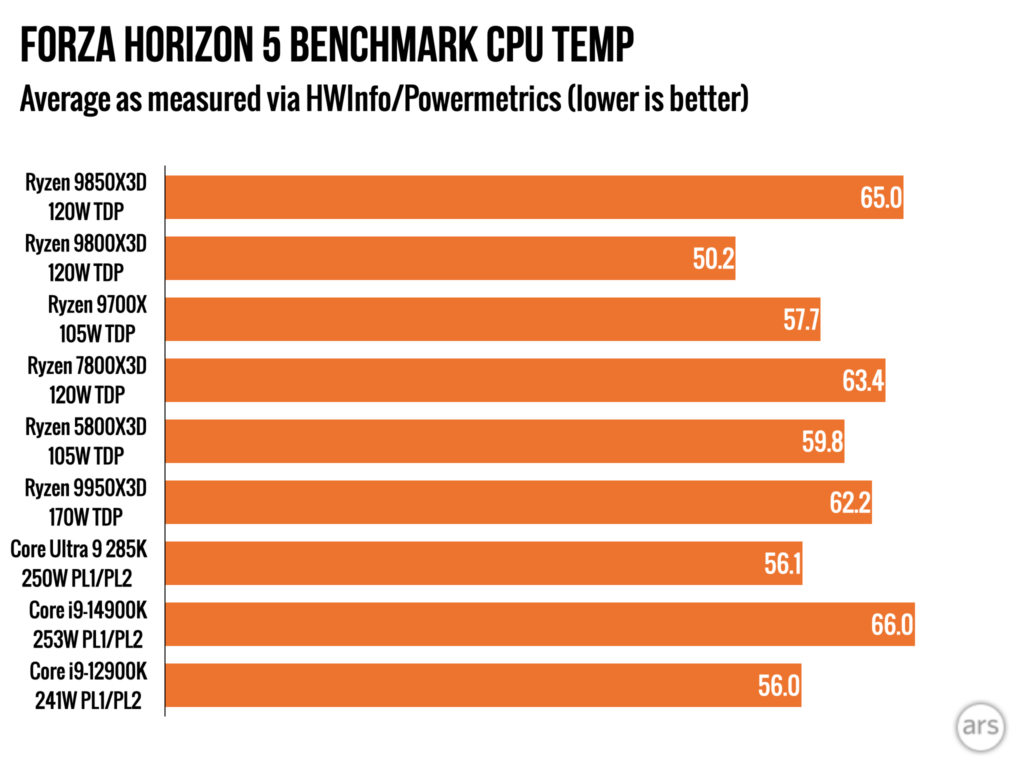
While the 9850X3D’s power consumption while gaming isn’t wildly out of step with the 9700X’s or the 9950X3D’s, it does make the tiny performance gains on display here hard to get excited about.
And this is on top of the cost trade-off you’re already making when you buy an X3D-series chip. Game performance is always impressive, but you notice those benefits the most in situations where your CPU, not the GPU, is the performance bottleneck.
Most of the time in a gaming PC, that’s only going to be the case when you’re trying to play games at extremely high frame rates at lower resolutions. It’s less useful when trying to play games at 4K or even 1440p, where your graphics card will be the limiter. If you’re building a system around any GPU slower than an RTX 4080 or 5080, going with a regular 9700X and putting the savings toward your GPU (or toward an eye-wateringly expensive RAM kit) will usually be a better use of funds.
Probably not worth it
The Ryzen 7 9850X3D mostly does what it says it does: It’s a mild speed bump to AMD’s best gaming processor that, in most cases, very slightly extends the company’s performance lead over Intel chips like the Core Ultra 9 285K.
But the vanilla 9800X3D is almost as fast, uses 25 or 30 W less power during gaming (which also results in temperatures that are 10° to 15° Celsius cooler), and is $30 cheaper as of this writing.
As someone who routinely runs his own Ryzen desktop chips in Eco Mode to reduce power consumption and temperatures and hit a more efficient spot on the performance-per-Watt curve, the numbers that the 9850X3D posted in our testing make it seem like an undesirable trade-off, even if you’re in the target market for a fast-as-possible, money’s-no-object, bragging-rights gaming PC.
The good
AMD's Ryzen 7 9850X3D. Credit: Andrew Cunningham
AMD has released three distinct generations of its 3D V-Cache technology, which initially appeared in the Ryzen 7 5800X3D in 2022. The kernel of the idea has remained the same throughout AMD’s efforts: take an existing desktop processor design and graft 64MB of additional L3 cache onto it.
This approach disproportionately helps apps that benefit from more cache, particularly games, and the size of the boost that 3D V-Cache gives to game performance has always been enough to offset any downsides these chips have come with. In the four years since the 5800X3D was released, AMD also has steadily chipped away at those disadvantages, adding more CPU cores, improving power consumption and temperatures, and re-adding the typical Ryzen range of overclocking controls.
AMD’s new Ryzen 7 9850X3D, which launches for $499 starting tomorrow, is the very definition of a mild upgrade. It’s the year-old Ryzen 7 9800X3D but with an extra 400 MHz of turbo boost speed. That’s it. That’s the chip.
But it is mildly interesting that the 9800X3D’s 5.6GHz boost clock is now 100 MHz higher than that of the Ryzen 7 9700X, the chip’s nearest non-V-Cache equivalent. It’s not nearly as interesting as an actual new chip, but it does mean AMD has closed the last major functional gap between the V-Cache and non-V-Cache Ryzen chips (the pricing gap remains; the 9700X currently retails for around $329).
It also means that the 9850X3D behaves more like a 9700X in other ways—differences that likely won’t matter to its target audience but which do distinguish it from being “just a faster 9800X3D.”
Chip recap
The biggest change AMD made to the Ryzen 9000 version of the X3D chips is that the 3D V-Cache is now stacked underneath the CPU silicon rather than on top. This has the benefit of moving the CPU cores closer to your heatsink or AIO loop, making them easier to keep cool.
The 9850X3D remains an eight-core chip based on AMD’s Zen 5 architecture. All eight of those CPU cores have access to the 3D V-Cache, unlike the 12-core and 16-core Ryzen 9 9900X3D and 9950X3D. In each of those chips, one of the CPU chiplets has access to the 3D V-Cache and one doesn’t; AMD’s chipset software is responsible for making sure apps run on the type of CPU core that will maximize the app’s performance. AMD’s software is pretty good at this, but it’s not foolproof, which can make the 9800X3D and 9850X3D more appealing and cost-effective options for PCs that will mainly be used for gaming.
AMD AM5 | Intel LGA 1851 | Intel LGA 1700 | AMD AM4 | |
|---|---|---|---|---|
CPUs | Ryzen 7000 and 9000 series | Core Ultra 200 series | 12th, 13th, and 14th-generation Core | Ryzen 5000 series |
Motherboard | ASRock X870E Taichi or MSI MPG X870E Carbon Wi-fi (provided by AMD) | MSI MEG Z890 Unify-X (provided by Intel) | Gigabyte Z790 Aorus Master X (provided by Intel) | Asus ROG Crosshair VIII Dark Hero (provided by Asus) |
RAM config | 32GB G.Skill Trident Z5 Neo (provided by AMD), running at DDR5-6000 | 32GB G.Skill Trident Z5 Neo (provided by AMD), running at DDR5-6000 | 32GB G.Skill Trident Z5 Neo (provided by AMD), running at DDR5-6000 | 32GB DDR4-3200 |
The specs in our CPU testbed are the same as they’ve been for a while. We’ll be focused on comparing the 9850X3D to its predecessors, the 5800X3D, 7800X3D, and 9800X3D, as well as the non-V-Cache 7700X and 9700X. We’ll also include numbers from the higher-end 9900X3D and 9950X3D. Intel’s side of the fence will be represented by the Core Ultra 9 285K and the last few generations of Core i9 chips, though Intel has yet to release any chips that are truly performance-competitive with the 3D V-Cache chips in gaming workloads.
Though our testbed continues to rely on DDR5-6000, AMD’s slide deck takes the current (horrible) state of the RAM market into account. While DDR5-6000 or DDR5-6400 is generally still the performance sweet spot for all socket AM5 CPUs, AMD notes that game performance between the 9850X3D with DDR5-6000 and the same chip with DDR5-4800 can be as little as 1 to 2 percent. In other words, pair whatever RAM you can find with this chip and don’t worry about it too much.
Performance and power consumption
The first thing to notice about the 9850X3D is that its multi-core performance is essentially indistinguishable from the 9800X3D. If anything, the 9800X3D seems marginally better behaved in our Handbrake video encoding tests, which could come down to anything or nothing—maybe it’s an actual difference between the chips, maybe it’s the silicon lottery, maybe it’s something else. Overall, it’s mostly a wash.
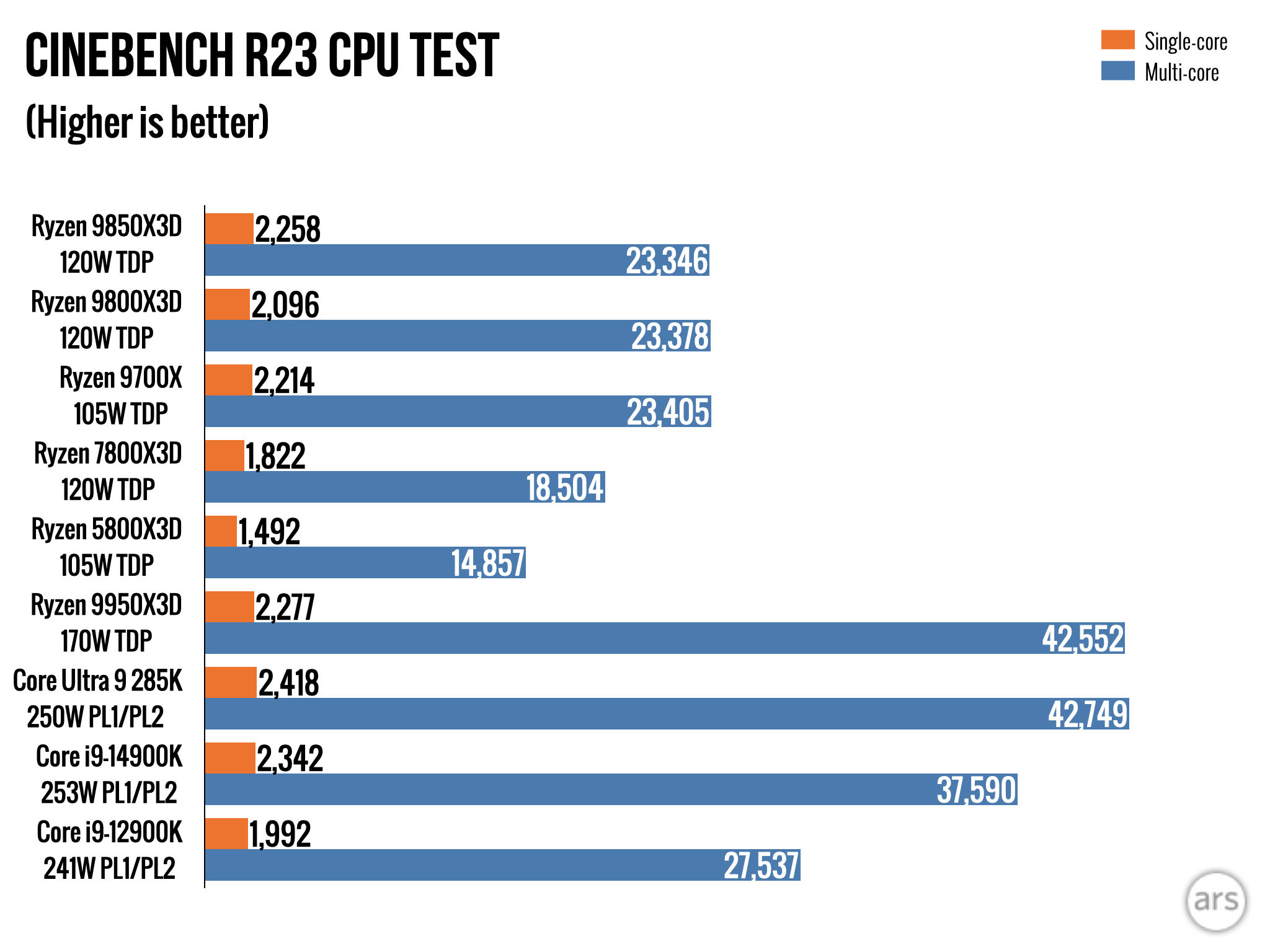
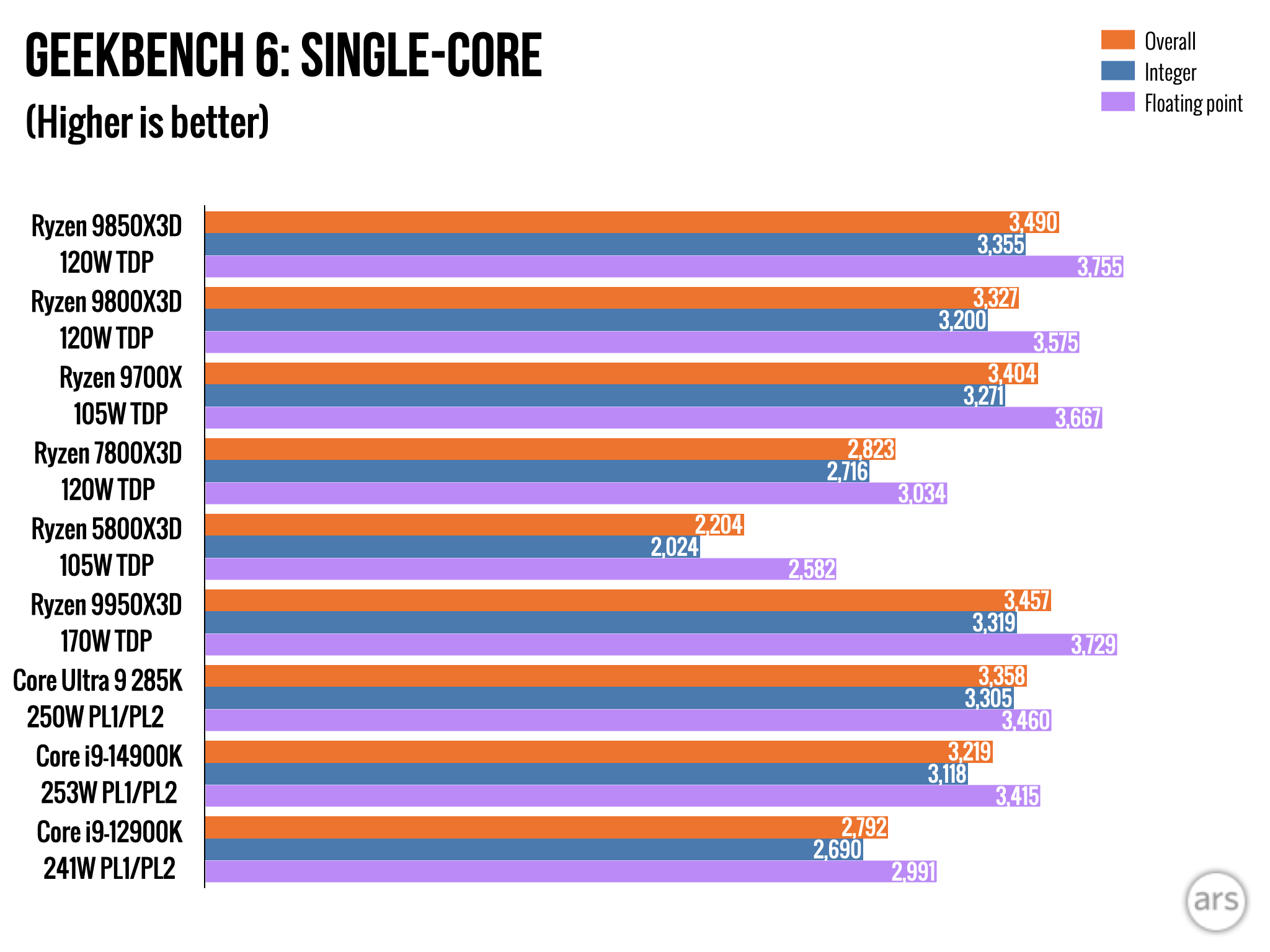
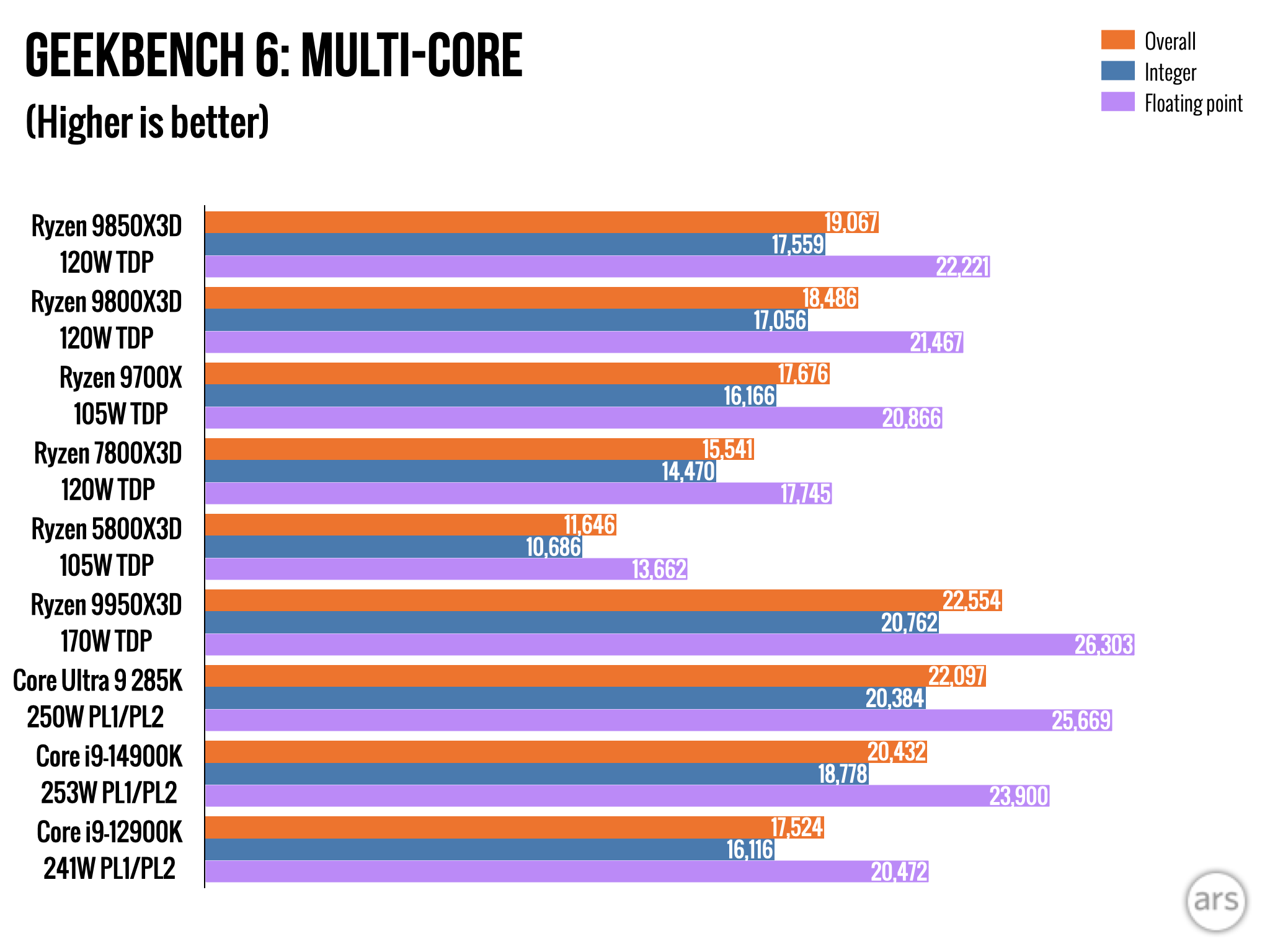
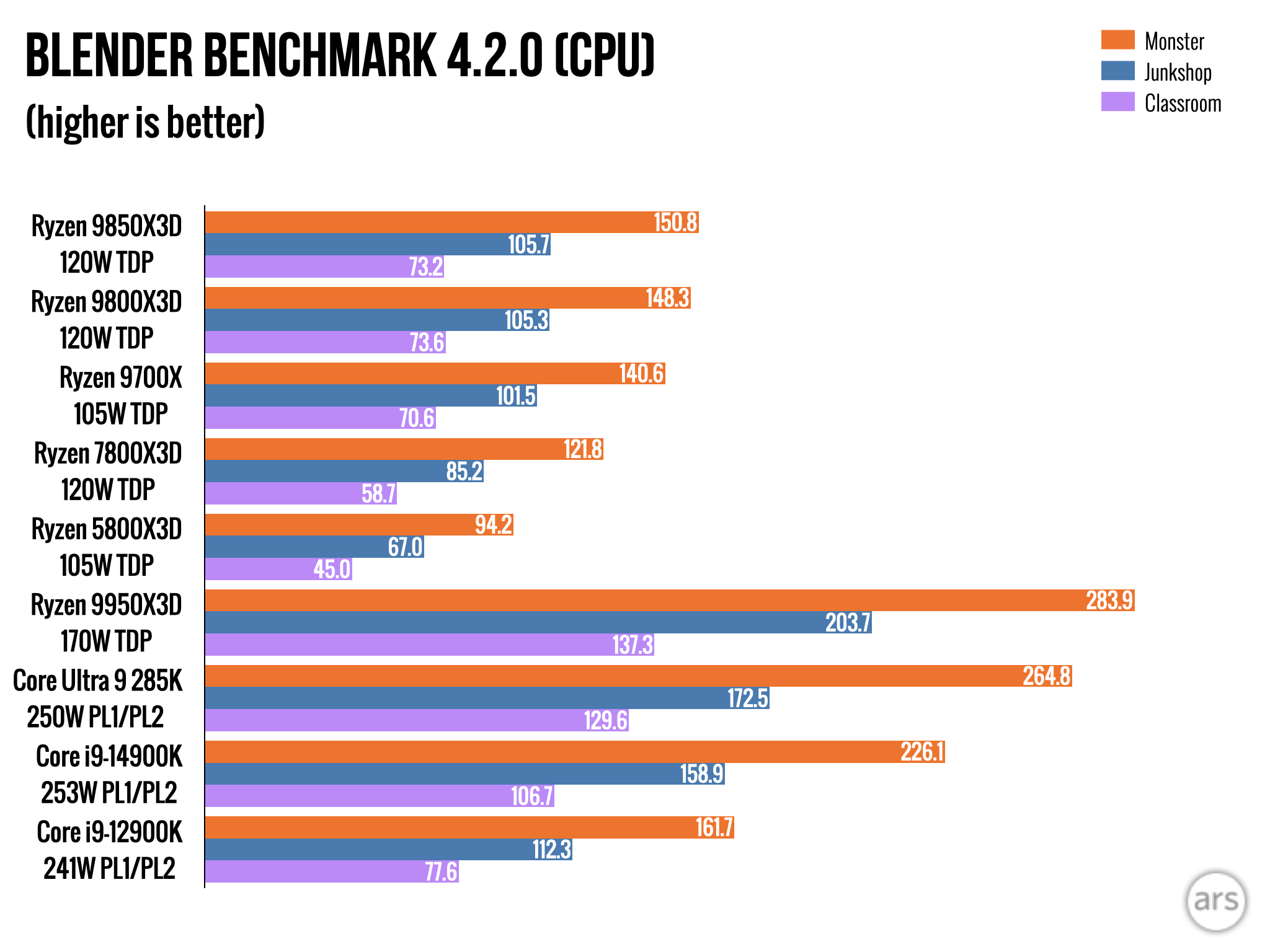
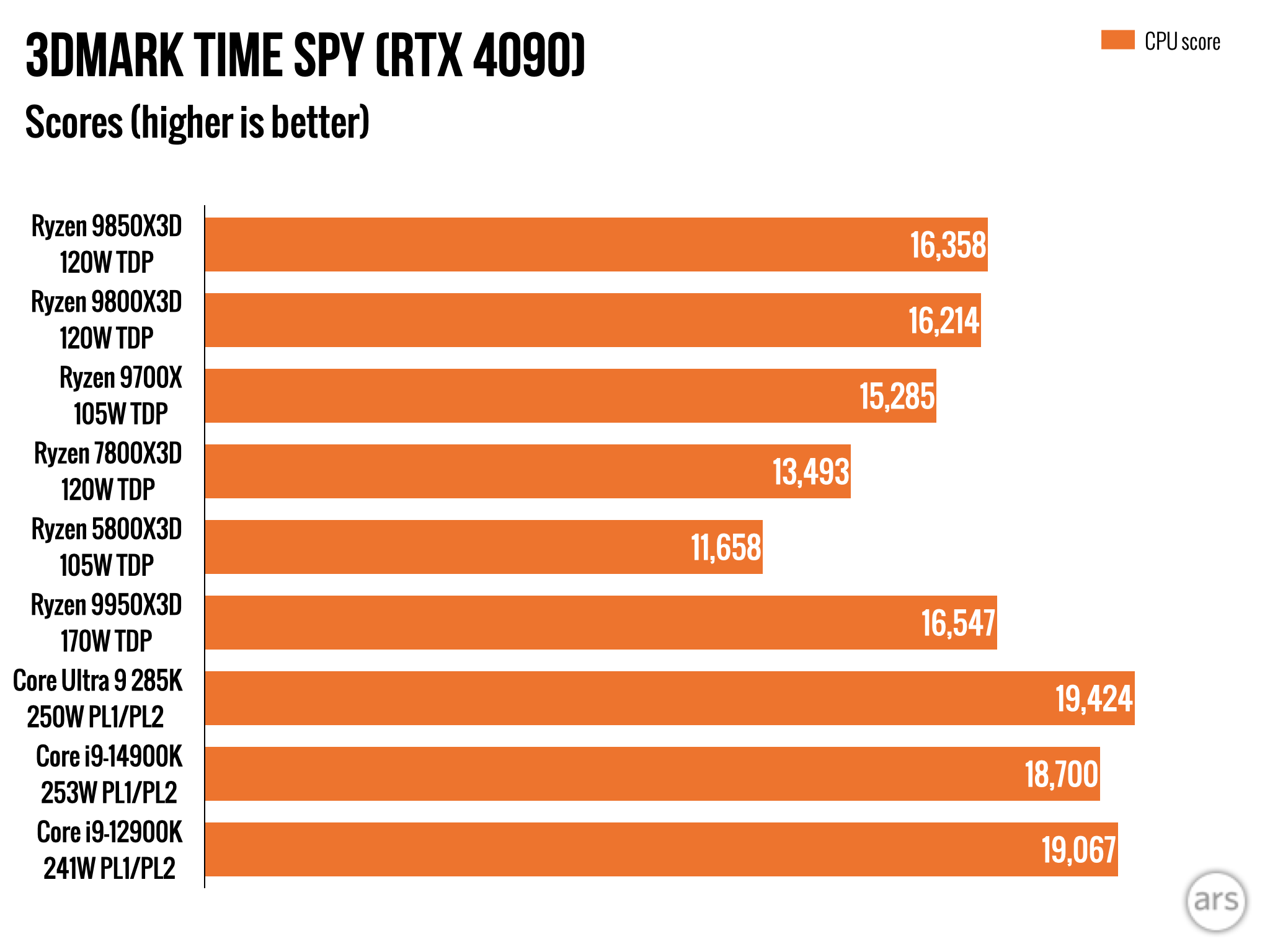
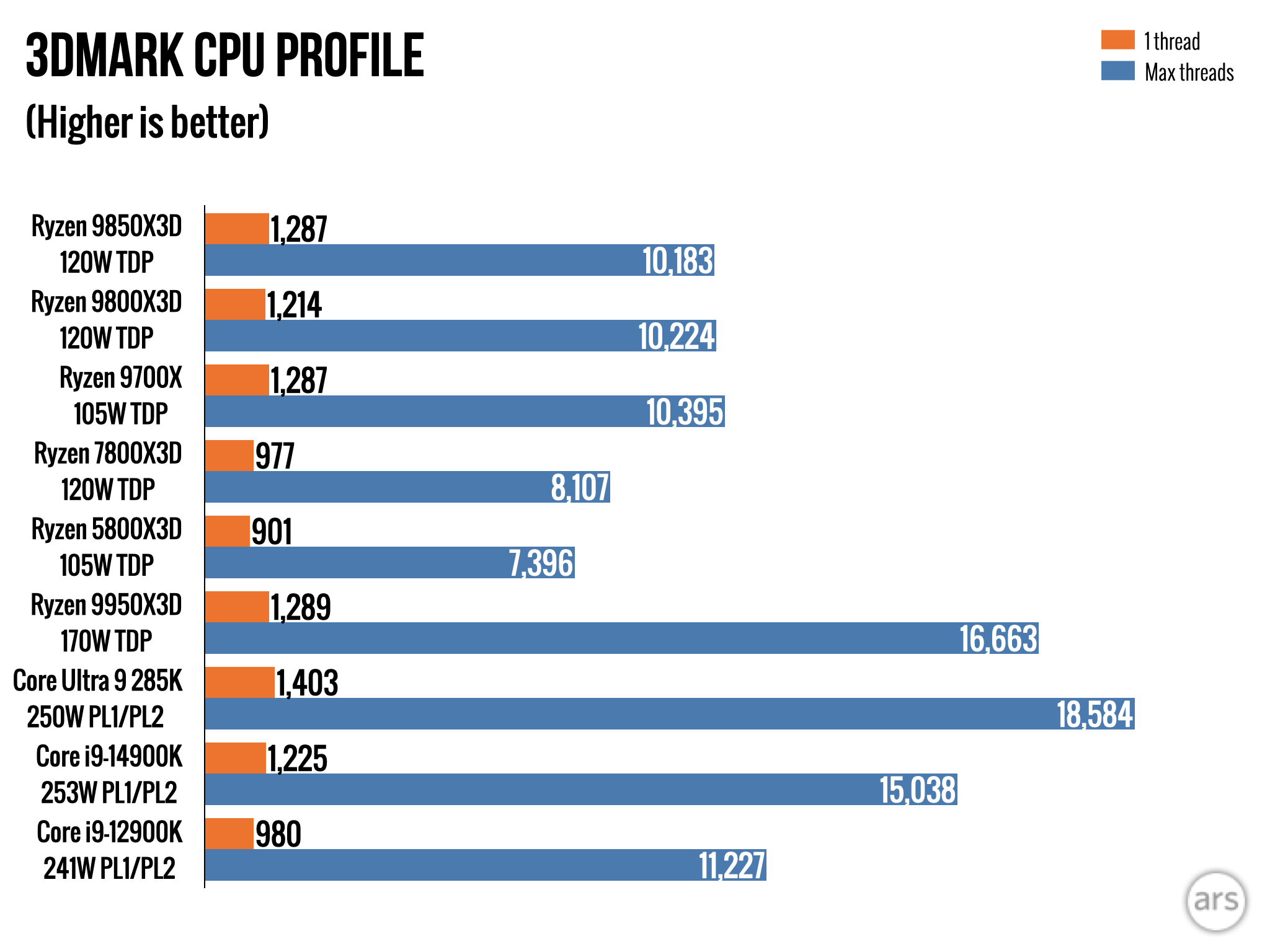
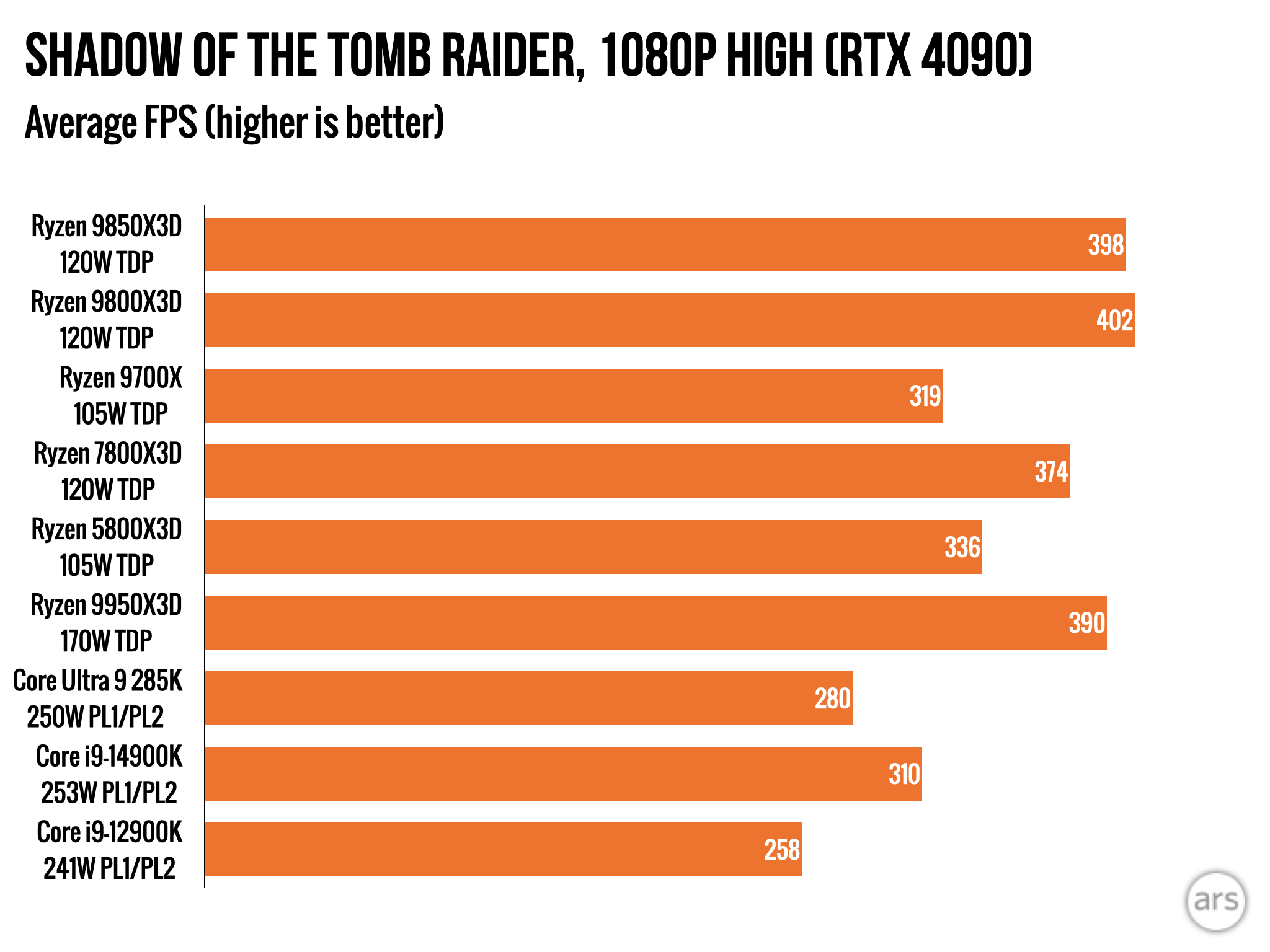
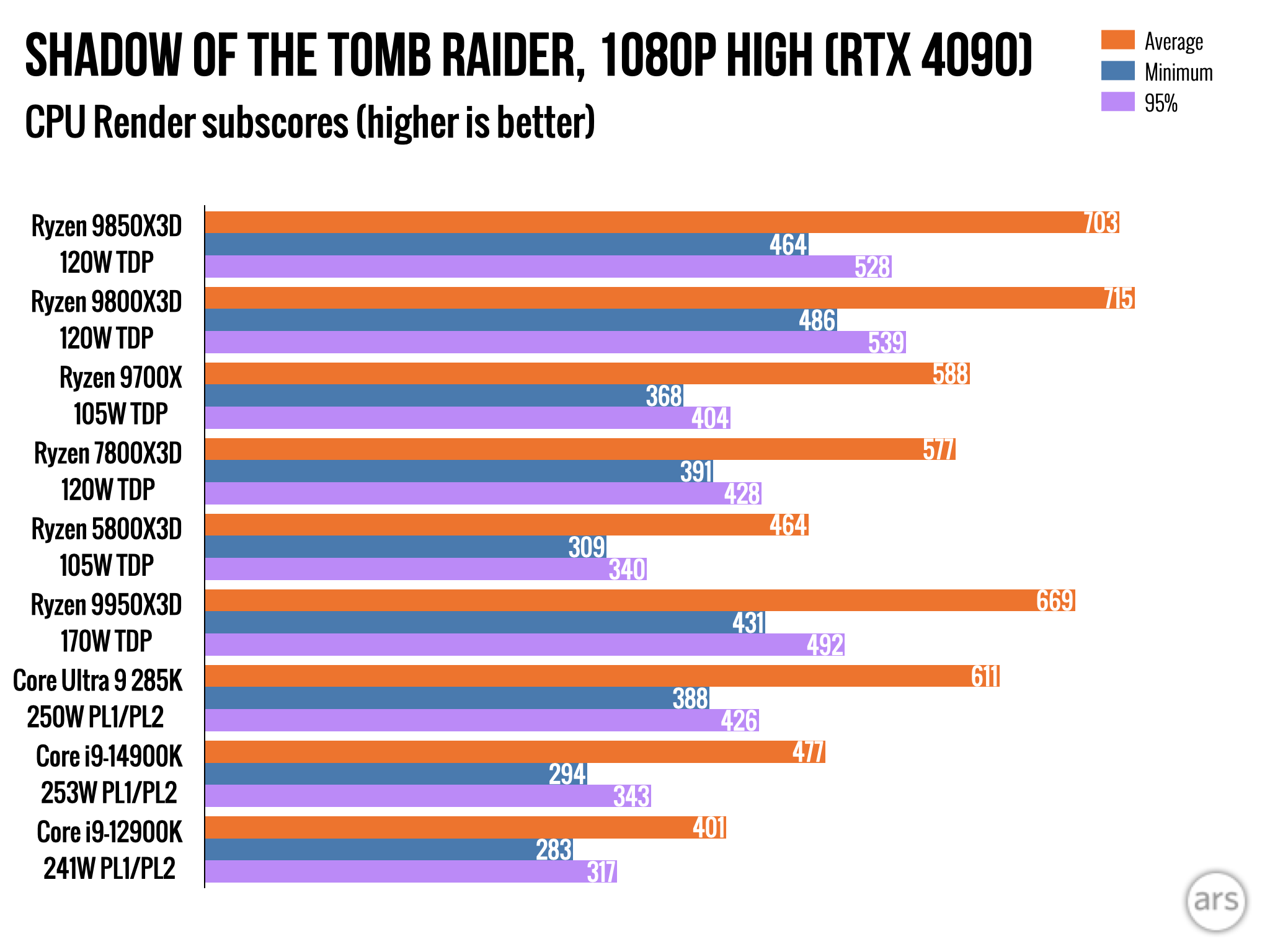
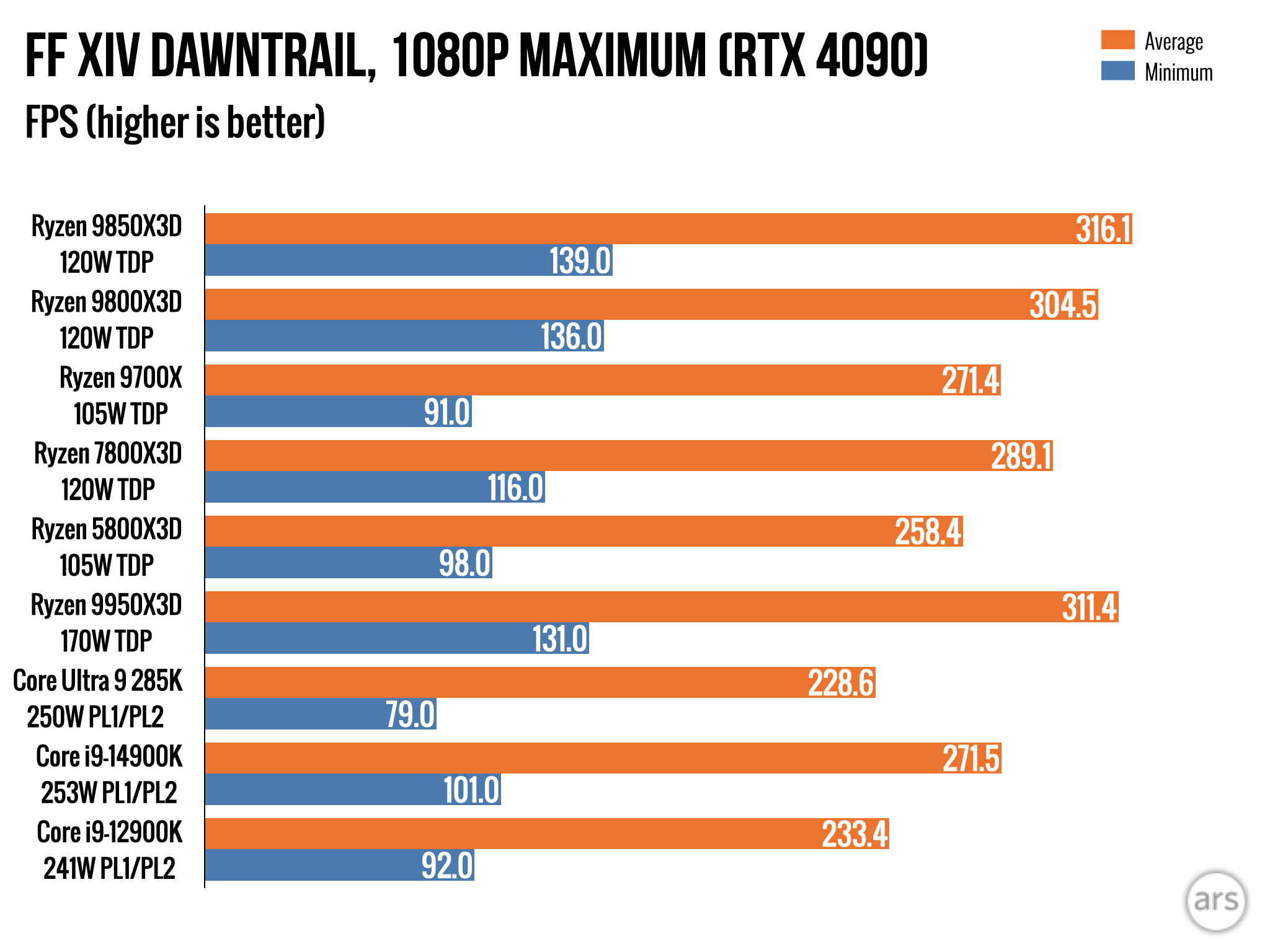
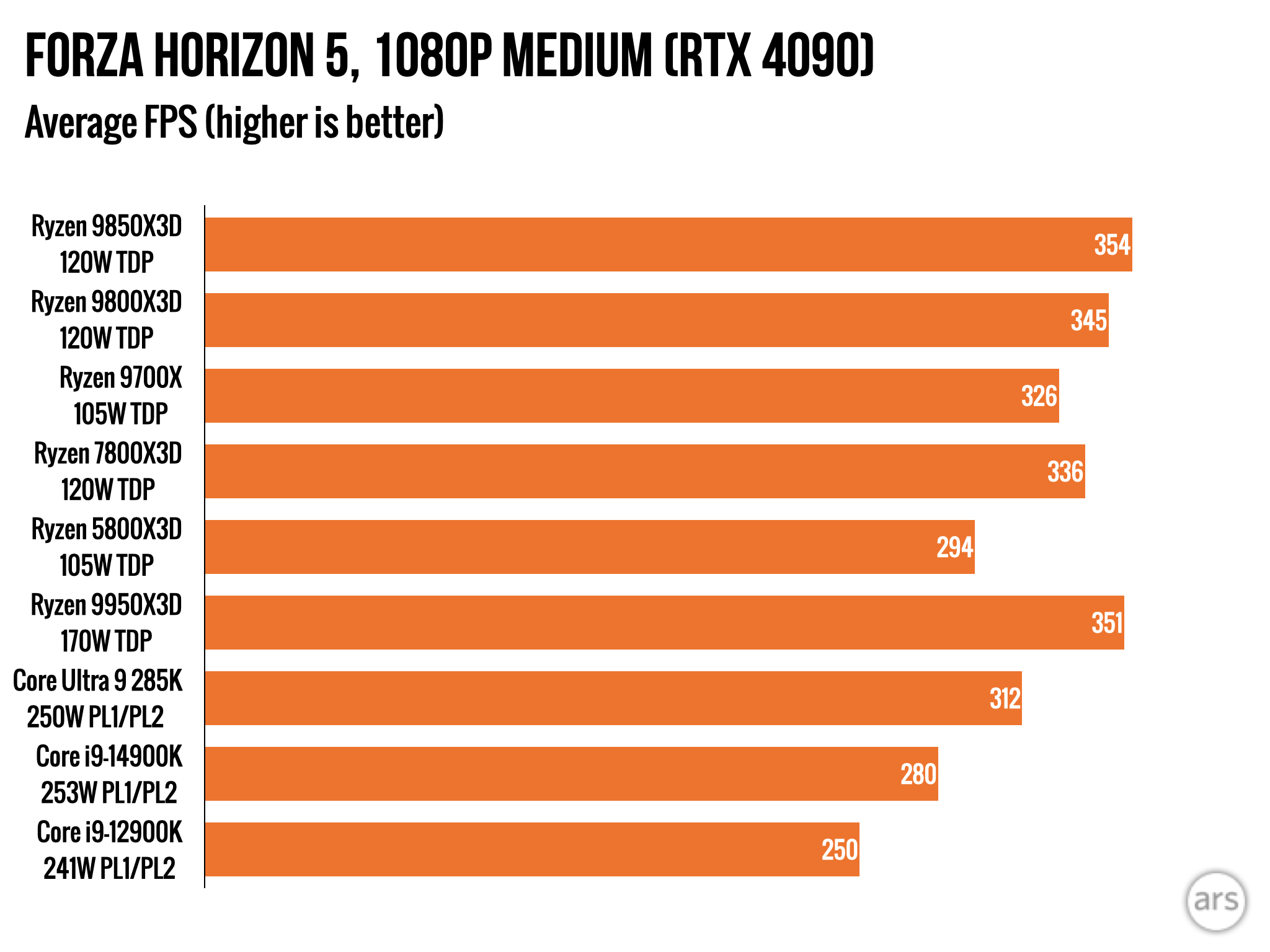
The 9850X3D does improve significantly on the 9800X3D’s single-core performance, closing the gap with both the Ryzen 9900X3D and 9950X3D (both of which have regular Zen 5 cores with no 3D V-Cache) and the 9700X (which has no 3D V-Cache at all).
There’s a world in which AMD can get this extra performance for “free” without changing anything about the architecture or manufacturing process. AMD could have been “binning” silicon lottery winners, or the reliability of the manufacturing process could have improved enough to allow AMD to hit better numbers that weren’t as consistently achievable a year ago.
But it looks like AMD improved the 9850X3D’s single-core performance mainly by making it behave more like a non-X3D chip. The chip’s power consumption while gaming suggests this is more or less what’s happening—the 9850X3D’s CPU package power while gaming is some 25 or 30 W higher than the 9800X3D playing the same games, despite the single-digit-at-best performance improvement (in both our testing and AMD’s advertising).
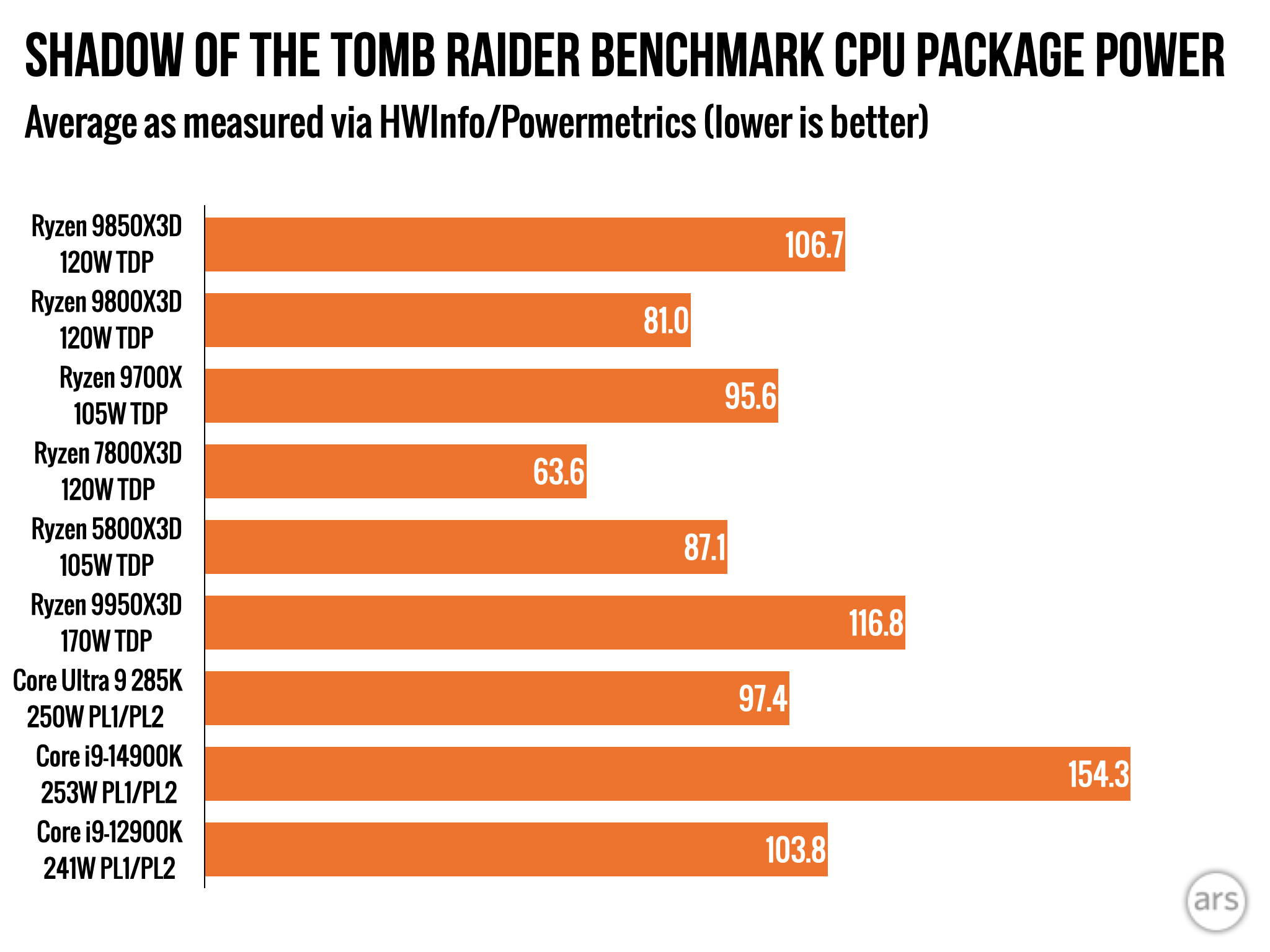
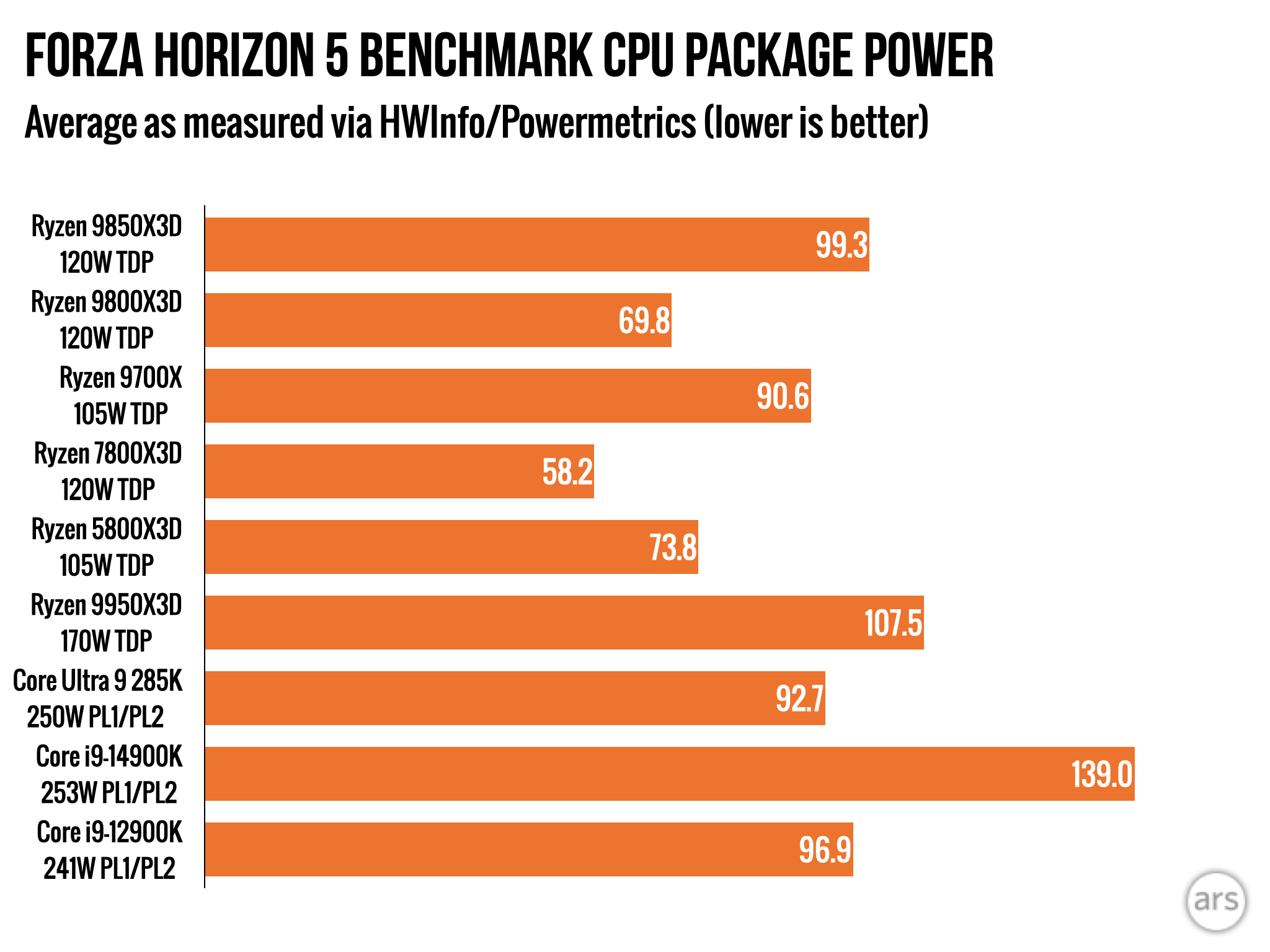
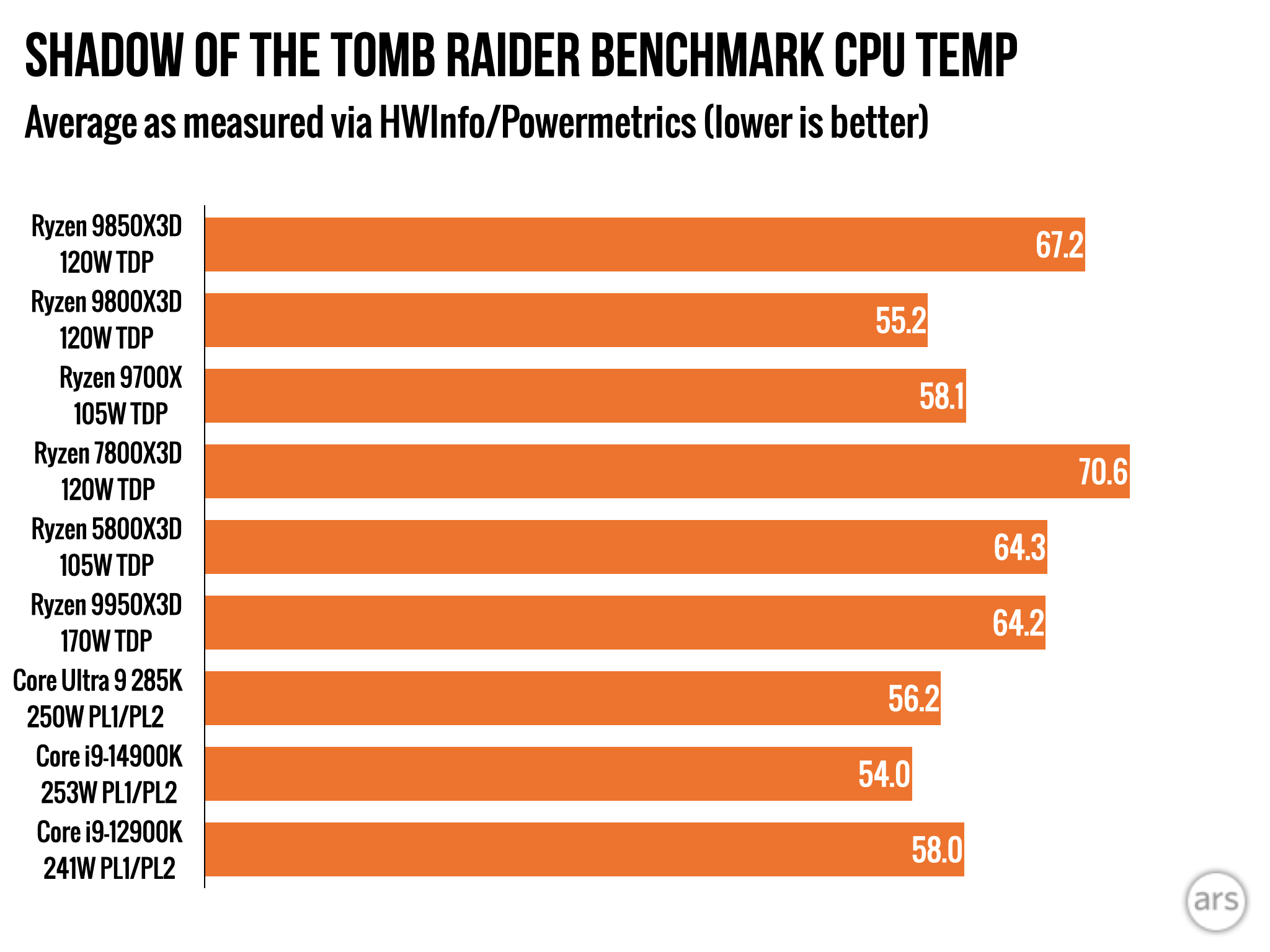
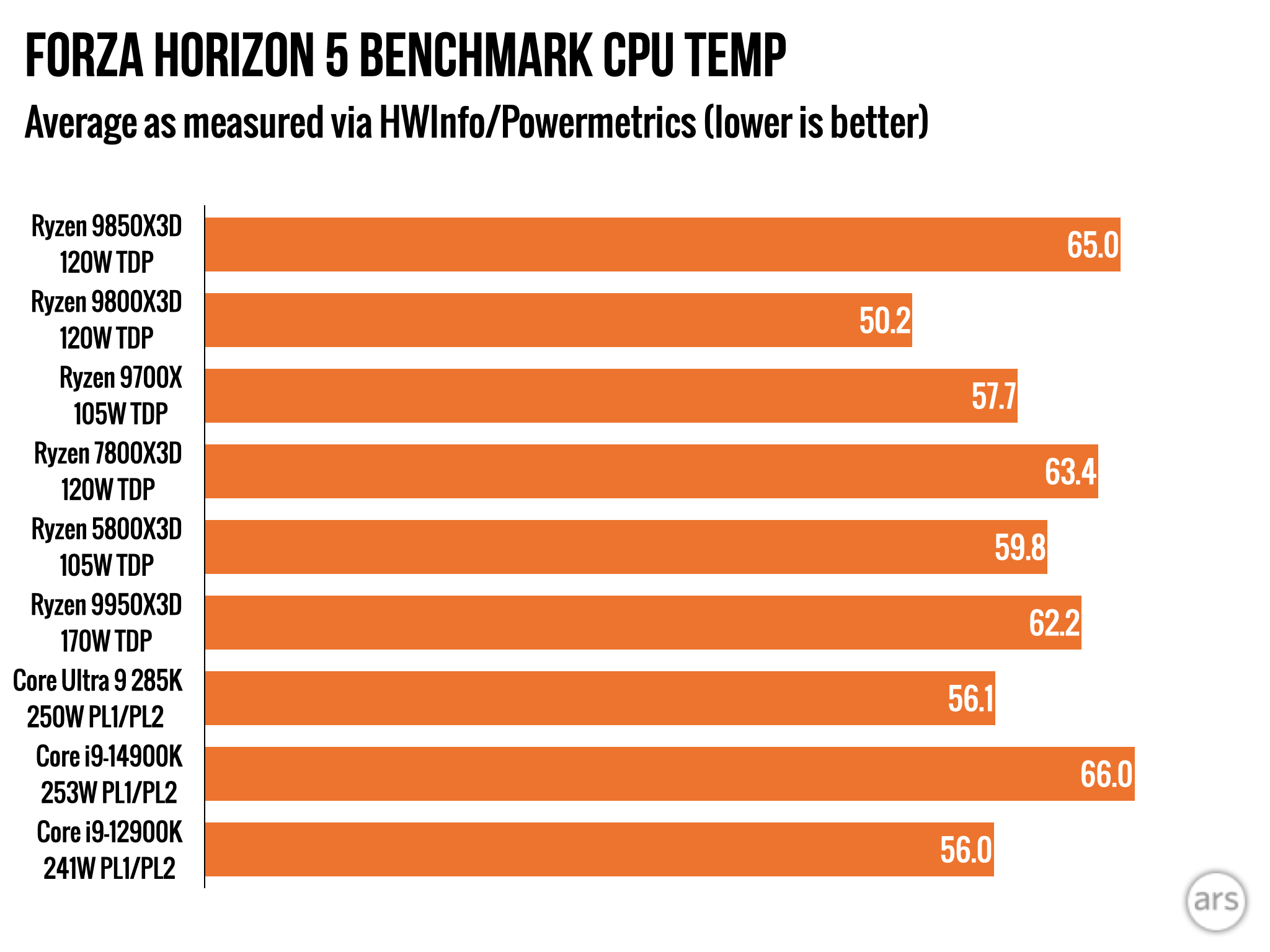
While the 9850X3D’s power consumption while gaming isn’t wildly out of step with the 9700X’s or the 9950X3D’s, it does make the tiny performance gains on display here hard to get excited about.
And this is on top of the cost trade-off you’re already making when you buy an X3D-series chip. Game performance is always impressive, but you notice those benefits the most in situations where your CPU, not the GPU, is the performance bottleneck.
Most of the time in a gaming PC, that’s only going to be the case when you’re trying to play games at extremely high frame rates at lower resolutions. It’s less useful when trying to play games at 4K or even 1440p, where your graphics card will be the limiter. If you’re building a system around any GPU slower than an RTX 4080 or 5080, going with a regular 9700X and putting the savings toward your GPU (or toward an eye-wateringly expensive RAM kit) will usually be a better use of funds.
Probably not worth it
The Ryzen 7 9850X3D mostly does what it says it does: It’s a mild speed bump to AMD’s best gaming processor that, in most cases, very slightly extends the company’s performance lead over Intel chips like the Core Ultra 9 285K.
But the vanilla 9800X3D is almost as fast, uses 25 or 30 W less power during gaming (which also results in temperatures that are 10° to 15° Celsius cooler), and is $30 cheaper as of this writing.
As someone who routinely runs his own Ryzen desktop chips in Eco Mode to reduce power consumption and temperatures and hit a more efficient spot on the performance-per-Watt curve, the numbers that the 9850X3D posted in our testing make it seem like an undesirable trade-off, even if you’re in the target market for a fast-as-possible, money’s-no-object, bragging-rights gaming PC.
The good
- Faster than the 9800X3D most of the time, particularly in single-threaded tasks.
- AMD has steadily closed all of the performance gaps that used to exist between the X3D series and the non-3D-V-Cache Ryzen chips.
- Power consumption and temperatures are generally reasonable and in line with other Zen 5 CPUs.
- The price of RAM. The price of GPUs. The price of SSDs. It’s a decent time to be looking at a drop-in CPU upgrade; it’s a miserable time to be changing sockets or building a new system from scratch.
- The Ryzen 7 9800X3D is a bit cheaper, is nearly as fast, and is cooler-running and more efficient when gaming.
- In exchange for a high-single-digit performance gain, games and some other single-core workloads can use as much as 30 or 40 percent more power.
